Enter your puppy's birth date to get its exact age in weeks and months, its human-year age and a countdown to its next birthday. Instant and free.
🎂 Birthday Calculator
Live — updates as you change inputs.
Start with your pet’s details.
Choose a valid date to see your results.
Puppy age in weeks, months and human years
Puppy age
Weeks
Months
Human years (approx.)
8 weeks
8
1.8
2
12 weeks
12
2.8
3
16 weeks
16
3.7
5
6 months
26
6.0
8
9 months
39
9.0
11
1 year
52
12.0
15
18 months
78
18.0
20
2 years
104
24.0
24
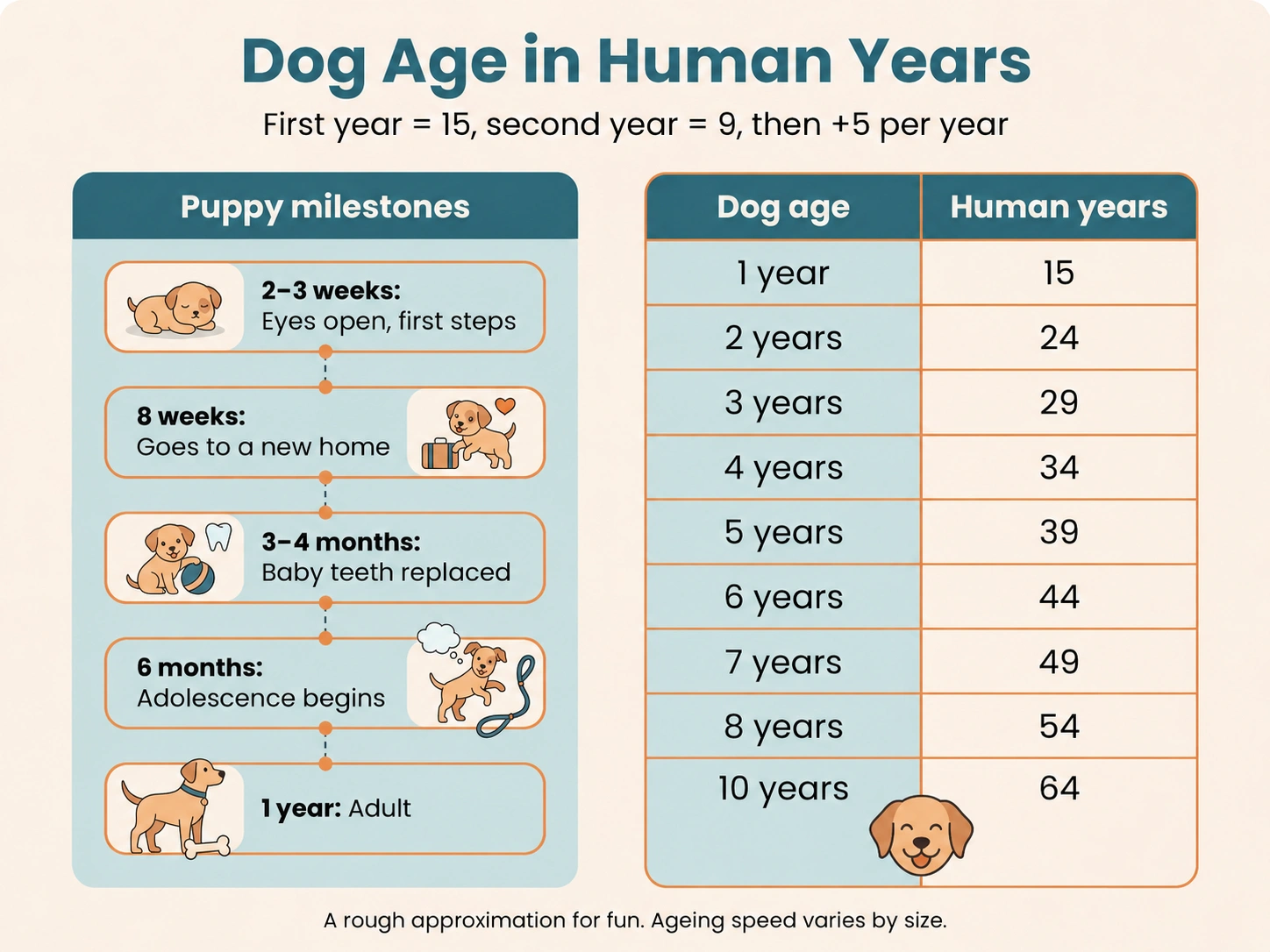
Human years use the calculator's formula: 15 for year one, 9 for year two, then 5 a year.
Birthday and milestone guide
How to use the pet birthday calculator
Pick dog or cat, enter your pet's name (optional) and birth date, and press calculate. If you do not know the real date, use an estimate: your adoption day or an estimate from your vet works fine.
The result shows exact age in days, weeks, months and years, the date and countdown to the next birthday, a rough human-year equivalent, a simple life stage, a list of milestones reached and coming up, and a few celebration ideas.
Understanding your results
Exact age. For young animals, weeks are more useful than months. A puppy or kitten changes a lot between 8 and 16 weeks, which is when most vaccines, socialisation and training begin. Your vet will set the vaccine schedule for your pet.
Human years. The calculator counts the first year as 15 human years and the second as 9, then adds 5 per year for dogs and 4 per year for cats. It is an approximation for fun and context. For dogs, ageing speed depends on size, so use the dog age calculator for size-specific figures and the cat age calculator for cats.
Life stage. Puppy or kitten means under one year, adult one to seven, and senior seven and over. These are broad bands. Giant dogs are considered senior earlier and small dogs later, so ask your vet when to change food or start senior check-ups.
Milestones. The list shows common developmental points, such as eyes opening, going to a new home, teething and adolescence. Ages are typical and individual pets vary by weeks or months.
Keep it short and calm. A walk, a favourite toy and a small treat beat a party for most pets. Treats should stay at about 10% of daily calories or less, so count them in the day's food (use the dog food calculator to see the target).
Safe birthday treats for dogs
Treat
Notes
Plain cooked chicken or turkey
No seasoning, bones or skin. Keep portions small.
Peanut butter (xylitol-free)
Read the label first: xylitol is highly toxic to dogs. Use a small spoonful.
Plain cooked sweet potato
Naturally sweet and easy to mash into a frozen treat.
Banana
A few slices at most; it is high in sugar.
Watermelon (seedless, no rind)
Hydrating, good for warm days.
Plain cooked egg
A simple protein treat.
Carrot sticks
Low calorie; raw or lightly steamed.
Dog-safe birthday cake from a pet bakery
Look for cakes made without chocolate, xylitol or raisins.
Plain frozen yogurt (tiny amount)
Check for xylitol. Many dogs are lactose-sensitive, so go easy.
Safe birthday treats for cats
Treat
Notes
Plain cooked salmon or tuna
A small flake or two. Not a meal replacement.
Plain cooked chicken
No seasoning, no bones.
Commercial cat treats
Pick a quality brand and count the calories.
Freeze-dried meat treats
Single-ingredient options are a simple choice.
Catnip or silvervine (enrichment, not food)
Most cats, though not all, respond.
Plain cooked prawn (small piece)
Remove the shell and tail completely.
Foods to avoid, birthday or not
Food
Why it is a risk
Chocolate
Contains theobromine, toxic to dogs and cats. Dark and baking chocolate are the most dangerous.
Xylitol (artificial sweetener)
Can cause a dangerous drop in blood sugar and liver damage in dogs. Found in some peanut butters and sugar-free products.
Grapes and raisins
Linked to kidney failure in dogs, even in small amounts.
Onions and garlic
Can damage red blood cells in dogs and cats.
Macadamia nuts
Toxic to dogs: weakness, vomiting, tremors.
Alcohol
Toxic to pets. Keep drinks out of reach at parties.
Caffeine
Coffee, tea and energy drinks can be dangerous.
Avocado
The pit is a choking and blockage risk, and the flesh can upset the stomach.
Cooked bones
Can splinter and injure the mouth or gut.
Sugar-free baked goods
May contain xylitol. Check the ingredients.
If your pet eats any of these, contact your vet or a pet poison hotline right away. Do not wait for symptoms. Pets with allergies, diabetes, pancreatitis or other conditions need vet advice before any new treat.
Ideas by life stage
Puppy or kitten. Keep it quiet. Young animals tire and overstimulate easily. A new toy, a treat and a photo are plenty, and avoid crowds of unfamiliar people or animals. Check with your vet about vaccines before any playdates.
Adult. A new trail or beach for dogs, a puzzle feeder or climbing shelf for cats. Variety and one-on-one time matter more than spending.
Senior. Choose comfort and routine: a gentle walk, a soft bed, a treat that suits their diet. Changes in appetite, weight or mobility are worth a vet visit, not just a birthday.
Dog and cat milestone timeline
Age
Dogs
Cats
2–3 weeks
Eyes open, first steps
Eyes open at about 1 week, first steps by about 3 weeks
8 weeks
Common age to go to a new home
Common age to go to a new home
3–4 months
Baby teeth start to be replaced
Baby teeth start to be replaced
6 months
Adolescence begins; adult teeth mostly in by about 6–7 months
Adolescence begins; adult teeth mostly in by about 6–7 months
1 year
Adult by most calculators; large breeds may keep growing
Adult
7 years
Senior for many medium and large dogs
Often treated as the start of the senior years
10 years
Senior for most small dogs
Senior
15 years
Reached by few dogs; more common in small breeds
Geriatric; reached by many well-cared-for indoor cats
Typical ages only. Individual pets differ, and breed size matters, especially for dogs. This is general information, not veterinary advice. Ask your vet about vaccines, dental care and when to start senior check-ups.
Frequently asked
Questions about this calculator
How do I calculate my dog's age in human years?
The calculator counts the first year as 15 human years and the second as 9 more (24 at age two), then 5 more per year for dogs and 4 for cats. It is a rough, widely used approximation, not the multiply-by-7 rule and not a medical measure.
Can dogs eat birthday cake?
Human birthday cake is not a good idea: sugar and butter upset the stomach, and chocolate, xylitol and raisins are dangerous. Use a cake from a pet bakery or a simple treat, such as sweet potato or xylitol-free peanut butter, in a small portion.
What can I give my cat for their birthday?
Plain cooked salmon, freeze-dried chicken treats, or a new catnip toy. Avoid onions, garlic, chocolate, and xylitol. Keep celebrations low-key — most cats find noise and crowds stressful.
What is my pet's life stage?
The calculator uses three broad stages for dogs and cats: puppy or kitten (under 1), adult (1 to 7) and senior (7 and over). Vets often use finer stages that depend on breed size, so ask yours about diet and check-ups.
Do pets know it is their birthday?
Pets don't understand calendar dates, but they enjoy extra treats, play, and attention. The celebration is meaningful for owners — marking time and the bond with their pet.
How does the calculator work out human years?
It uses a simple, widely used approximation: the first year counts as 15 human years, the second as 9 more (24 at age two), then 5 more per year for dogs and 4 more for cats. It is a rough guide for fun and context, not a medical measure. Real ageing varies with breed size, genetics and health. See the dog age calculator for size-specific conversions.
What life stages does the calculator use?
The calculator keeps it simple: puppy or kitten under 1 year, adult from 1 to 7 years, and senior at 7 and over. Vets often use more detailed stages that depend on breed size, so ask yours when planning vaccines, diet and check-ups.
How do I celebrate my dog's birthday on a budget?
An extra walk somewhere new, a play session with a favourite toy, and a small homemade treat cost almost nothing. A photo with a party hat is optional and many dogs tolerate it for a few seconds.
What should I do for my senior pet's birthday?
Think comfort: a soft bed, a slow walk to a favourite spot, gentle brushing or a massage, and a treat that fits their diet. If your senior has arthritis, skip stairs and slippery floors, and ask your vet before changing food.
I don't know my rescue pet's birthday. What should I do?
Ask your vet for an age estimate. Teeth, eyes, coat and body condition give a rough range, but it is only an estimate. Pick a date that works for you, such as the adoption day, and use it each year. The calculator will treat it as the birthday.
How do I convert my puppy's age from weeks to months?
Divide the age in weeks by 4.35. For example, 12 weeks is about 2.8 months and 26 weeks is 6 months.
Does a puppy age calculator change by breed?
Age in weeks and months is the same for every breed. Breed and adult size only change the human-year equivalent later in life, because larger dogs age faster after about 2 years.
Puppy age calculator: weeks, months and breed
Do you count a puppy's age in weeks or months? Vets and breeders count in weeks until about 16 weeks (vaccines, socialisation and rehoming rules are timed in weeks), then in months until about 2 years, then in years.
Age in weeks
Roughly in months
8 weeks
about 2 months
12 weeks
about 3 months (2.8)
13 weeks
3 months
16 weeks
about 3.7 months
26 weeks
6 months
52 weeks
12 months
To convert, divide weeks by 4.35 (the average number of weeks in a month).
Puppy age calculator by breed or weight: a puppy's age in weeks is the same whatever its breed. What breed and weight change is the human-year equivalent once your dog is grown, because large and giant dogs age faster after about 2 years. Use the dog age calculator for the size-adjusted human years.
Don't know the birth date? A vet can estimate age from the teeth: puppy teeth come in from about 3–6 weeks and the adult teeth are usually all through by about 6–7 months.
How we calculate
The math, openly documented.
Inputs
You enter the facts that change the estimate.
species · age · weight · lifestyle
Normalize
We validate ranges and convert units when needed.
lbs ↔ kg · months ↔ years
Formula
Published veterinary or industry-standard calculations.
result = f(valid inputs)
Results
Rounded outputs — schedules, ranges, or targets — with disclaimers.
The big milestones feel unforgettable in the moment and fade faster than expected, and the small ones get lost even sooner. Here's why a dated pet milestone timeline is worth keeping, what actually belongs in it, and how to make the habit stick.
"About four months old" is close enough for conversation and not close enough for a vaccine schedule or a socialization deadline. Here's why tracking your pet's exact age in weeks matters most during the first year and the senior years, and how to actually do it.
Orange, calico, tabby, tortoiseshell — cat coat color isn't a random draw, it's a handful of genes acting in predictable, well-mapped ways. Here's how they actually work.
 PetCalcStudio