Enter the breeding date to get your dog's due date, a week-by-week pregnancy timeline and whelping prep dates. Free dog pregnancy calculator.
Gestation timeline
Live — updates as you change inputs.
Start with your pet’s details.
Choose a valid date to see your results.
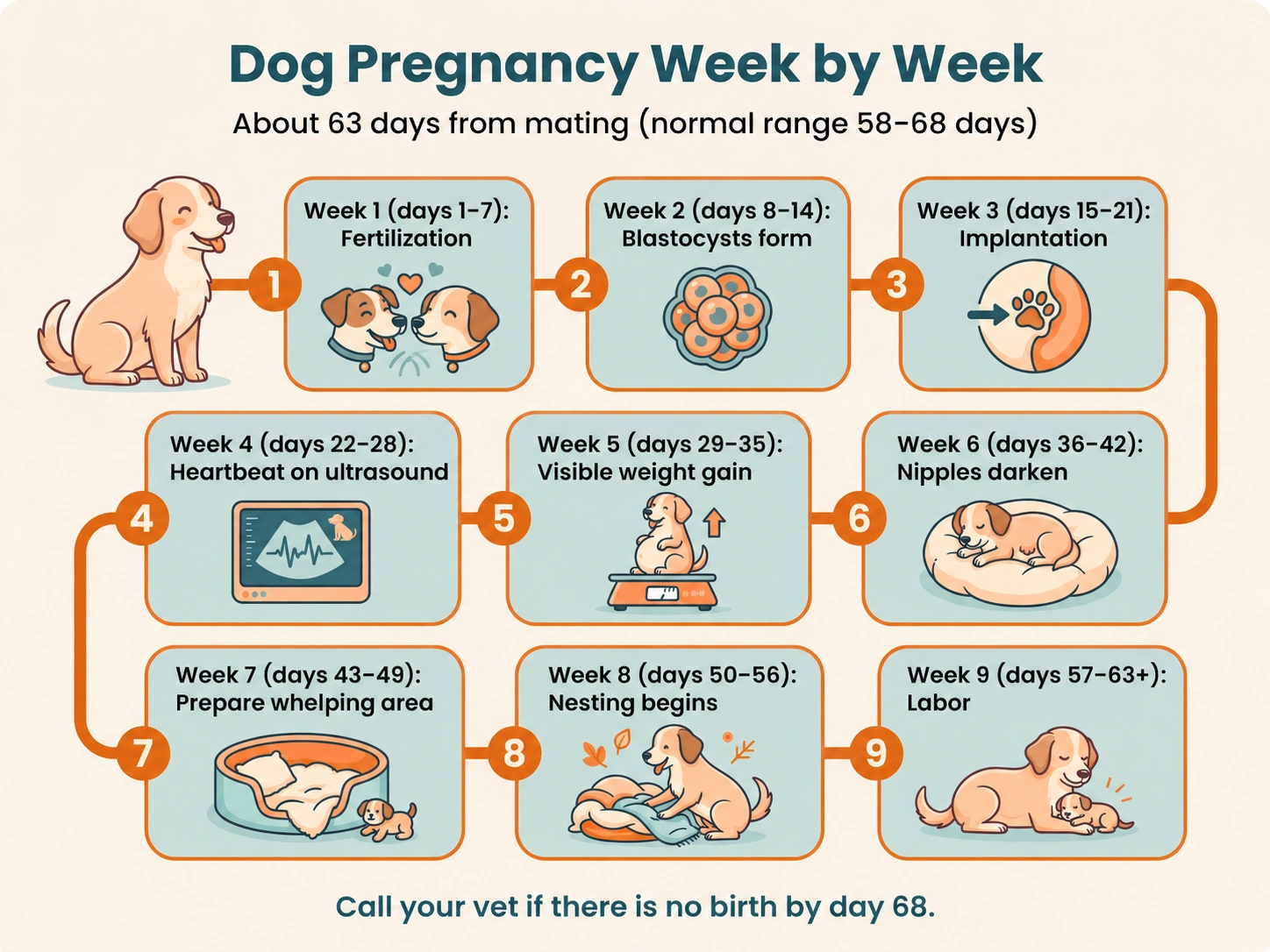
Dog pregnancy week by week (about 63 days)
Week
Days
What happens
1
1–7
Fertilization
2
8–14
Blastocyst formation
3
15–21
Implantation
4
22–28
Heartbeat detectable
5
29–35
Visible weight gain
6
36–42
Nipple changes
7
43–49
Prepare whelping area
8
50–56
Nesting begins
9
57–63+
Final week & labor
Dogs are pregnant for about 63 days from mating (usually 58–68). Call your vet if there is no birth by day 68.
Dog gestation guide
How to use the dog pregnancy calculator
Step 1 — Choose your date type. Most owners use the mating date. If your vet tracked an LH surge or ovulation, those dates can be more precise.
Step 2 — Enter the date. The calculator applies the standard 58–68-day delivery window (average 63 days from mating).
Step 3 — Select breed size (optional). Small breeds often whelp around day 62; large breeds around day 64.
Step 4 — Review the timeline. See current week, development notes, and labor signs. Confirm any concerns with your veterinarian.
Gestation formulas
Average due date = mating date + 63 days
Earliest delivery = mating date + 58 days
Latest delivery = mating date + 68 days
LH surge due date = LH date + 65 days
Ovulation due date = ovulation date + 63 days
Understanding your due-date window
Why the window spans 10 days rather than a single date. Unlike a fixed incubation period, canine gestation length varies by individual dog and depends on precisely when ovulation occurred relative to mating — sperm can remain viable in the reproductive tract for several days, so mating date and conception date aren't always the same day. This is exactly why a mating-date estimate returns a range rather than a single confident day.
LH and ovulation timing narrow the window considerably. If your vet tracked a luteinizing hormone (LH) surge or confirmed ovulation via progesterone testing during a planned breeding, that date anchors gestation length far more precisely than the mating date alone — this is standard practice for breeders managing a planned litter, since it also helps confirm true labor onset versus false alarms.
Breed size shifts the typical delivery day within the window. Smaller breeds often whelp a day or two earlier than the 63-day average, while larger breeds trend a day or two later — a modest effect, but worth factoring in when deciding how closely to monitor as the estimated date approaches.
What to do as the window opens. Start taking her rectal temperature twice a day a few days before the earliest date. A drop below about 99°F (37.2°C) often comes 8–24 hours before labor, but not every dog shows it, so treat it as one clue alongside nesting, restlessness and loss of appetite rather than a guarantee.
When to call your vet right away
Most litters arrive without help, but these are reasons to phone your vet or an emergency clinic at once, day or night:
Green or bloody discharge before the first puppy is born.
Strong, regular contractions for 30–60 minutes with no puppy.
A puppy visibly stuck in the birth canal.
More than 2–4 hours between puppies while she is still straining or clearly distressed.
Her temperature has dropped but there is no sign of labor after 24 hours, or no birth by day 68 from mating.
Fever, foul-smelling discharge, repeated vomiting, or extreme lethargy during pregnancy or after birth.
Panting, stiffness, tremors or a wobbly walk while nursing, which can be a calcium emergency called eclampsia.
A simple checklist before the due date
Book a confirmation ultrasound for about day 25–30 after mating.
Ask your vet about an X-ray from about day 55 if you want a reliable puppy count, and about the right food for late pregnancy.
Set up a quiet whelping box in a warm, low-traffic room about a week before the earliest date.
Keep clean towels, a digital thermometer and your vet and emergency clinic numbers where you can find them in the dark.
Write down the dates you mated and any vet-tracked ovulation dates, since they tighten the estimate.
This calculator gives an estimate from average gestation length. It cannot tell you whether your dog is pregnant, how many puppies to expect, or whether labor is going normally. Your veterinarian should confirm the pregnancy and guide her care. For more detail read our guide to dog gestation length and how to care for a pregnant dog.
Week-by-week dog pregnancy stages
Week 1 (days 1–7) — Fertilization
Fertilization occurs. Sperm meets egg and embryos begin cell division. No visible signs yet. Sperm can survive in the reproductive tract up to 7 days.
Week 2 (days 8–14) — Blastocyst formation
Zygotes divide repeatedly into blastocysts. Still no visible physical changes in the mother.
Week 3 (days 15–21) — Implantation
Blastocysts implant into the uterine wall (around days 18–21). Relaxin hormone production begins. Signs may include lethargy, tender nipples, morning sickness, and appetite changes.
Week 4 (days 22–28) — Heartbeat detectable
Heartbeats detectable via ultrasound. A vet can confirm pregnancy. Organs and facial features begin forming. Morning sickness may peak — feed bland food if vomiting.
Week 5 (days 29–35) — Visible weight gain
Fetuses develop gender organs. Belly starts to round and weight gain becomes noticeable. Increase food intake. Eyes begin forming.
Week 6 (days 36–42) — Nipple changes
Nipples darken and enlarge. Puppies develop skin pigment. Switch to high-quality puppy food and increase intake by about 35–50% above normal.
Week 7 (days 43–49) — Prepare whelping area
Puppy hair begins growing. Abdomen drops lower. Prepare a quiet whelping box, limit strenuous exercise, and keep the mother away from other animals.
Week 8 (days 50–56) — Nesting begins
Mother may start nesting. Colostrum production begins. You may see puppies moving in the belly. From about day 45 an X-ray can show skeletons, and from about day 55 it gives the most reliable puppy count.
Week 9 (days 57–63+) — Final week & labor
Appetite may reduce. A temperature below about 99°F (37.2°C) often comes 8–24 hours before labor. Labor signs include panting, shivering, restlessness, and contractions. Contact your vet if no birth by day 68.
Pregnancy signs & labor checklist
Early & mid-pregnancy signs
Decreased appetite (first few weeks)
Nipple swelling and darkening
Weight gain (noticeable from week 5)
Morning sickness / vomiting (weeks 3–5)
Lethargy and behavior changes
Belly enlargement (visible from week 6)
Nesting behavior (week 8+)
Temperature drop below about 99°F, a sign labor may be close
Labor signs
Body temperature drops below about 99°F, often 8–24 hours before labor
Restlessness and nesting
Loss of appetite
Panting and shivering
Visible abdominal contractions
Stage 1 labor lasts 6–12 hours before active delivery
Frequently asked questions
About 63 days (9 weeks) from mating, with a normal range of 58–68 days. Small breeds often deliver near day 62; large breeds near day 64.
How accurate is a dog due date calculator?
Dogs carry for about 63 days from ovulation. Counted from the mating date, the normal range is wider, about 56–72 days, because sperm can survive several days and mating doesn't always happen on the day of ovulation. Accuracy depends on what date you enter:
Date you enter
How accurate
Single mating date
±1 week
First of several matings
Up to about 1 week early
Ovulation from progesterone testing
Usually ±1–2 days (62–64 days)
LH surge date
Usually 64–66 days
Dog pregnancy week by week
Week
What happens
Vet checks
1–3
Fertilisation; embryos travel to and implant in the uterus
None needed
4
Heartbeats visible
Ultrasound from about day 25–30 confirms pregnancy
5–6
Belly and nipples enlarge; appetite rises
Gradually move her onto puppy or growth food
7
Puppies' skeletons harden
X-ray from about day 45 counts the puppies
8
Nesting behaviour; milk may appear
Prepare the whelping box
9
Whelping
Rectal temperature drops below about 99°F (37.2°C) roughly 12–24 hours before labour
When to call the vet during whelping
Call your vet if she has strong straining for 30 minutes or more without a puppy, more than 2–4 hours pass between puppies, there's green-black discharge before the first puppy, or she's past day 72 from mating. The dog heat cycle calculator helps time the next season, and the puppy weight calculator tracks the litter's growth.
Reference: Merck Veterinary Manual (canine pregnancy and parturition).
Dog due date calculator from ovulation
If your vet tracked progesterone, use the ovulation date: whelping is usually 63 days after ovulation, give or take 1–2 days. From the date of the LH surge it is usually 64–66 days. From a mating date, allow a wider window of about 58–68 days.
Dog whelping calculator: day-by-day milestones
Day (from mating)
What to do
Day 25–30
Ultrasound can confirm pregnancy
Day 45 onward
X-ray can count puppies
Day 55
Set up the whelping box and start taking her temperature twice a day
Day 58–68
Whelping window
Does gestation change by breed? Not much. Toy and giant breeds carry for about the same time. Small litters can sometimes run a little longer, and large litters a little shorter.
How we calculate
The math, openly documented.
Inputs
You enter the facts that change the estimate.
species · age · weight · lifestyle
Normalize
We validate ranges and convert units when needed.
lbs ↔ kg · months ↔ years
Formula
Published veterinary or industry-standard calculations.
result = f(valid inputs)
Results
Rounded outputs — schedules, ranges, or targets — with disclaimers.
display + notes
Questions about this calculator
How long are dogs pregnant?
About 63 days (9 weeks) from mating, with a normal range of 58–68 days. Small breeds often deliver near day 62; large breeds near day 64.
How accurate is this dog pregnancy calculator?
It is a strong estimate based on veterinary gestation averages. Individual dogs can whelp a few days earlier or later — confirm timing with your vet, especially for brachycephalic breeds.
When should I call the vet during pregnancy?
Schedule a confirmation ultrasound around day 25–28, a late-pregnancy check if you need a puppy count, and urgent care if labor does not progress or passes day 68 without delivery.
What if my dog hasn't given birth by day 68?
Contact your veterinarian immediately. Prolonged gestation past the normal window can endanger the mother and puppies.
Can sperm survival make the mating date inaccurate?
Yes. Sperm can remain viable for up to 7 days, so actual conception may be later than the mating you remember. LH surge or ovulation dates can refine the estimate when your vet provides them.
How do I know if my dog is in labor?
Common signs are a temperature drop below about 99°F (37.2°C), restlessness, panting, nesting, loss of appetite and visible contractions. Early labor often lasts 6–12 hours before puppies arrive. If she strains hard for 30–60 minutes with no puppy, call your vet.
Can the mating date be wrong?
Yes. Sperm can survive up to 7 days in the reproductive tract, so conception may occur days after mating. Use ultrasound timing from your vet for a tighter estimate when available.
What should I feed a pregnant dog?
Switch to high-quality puppy food by week 6 and increase intake by roughly 35–50% in late pregnancy. During lactation, many dogs need about twice their normal maintenance calories.
How many puppies will my dog have?
Litter size varies significantly by breed size — toy and small breeds commonly have 1-4 puppies, medium breeds 4-8, and large breeds 6-12 or more. An X-ray around day 55-58 can give a reasonably accurate puppy count, more reliable than an earlier ultrasound, which is better for confirming pregnancy than counting.
When should I take my dog for a pregnancy confirmation?
Ultrasound can confirm pregnancy as early as day 21-25 post-mating, detecting heartbeats reliably by day 28. Relaxin blood tests (which detect a hormone specific to pregnancy) can confirm as early as day 21-30 and are useful when ultrasound access is limited.
What supplies should I prepare before the due date?
A quiet, low-traffic whelping box set up at least a week in advance, clean towels, a digital thermometer for monitoring pre-labor temperature drop, and your vet's and an emergency clinic's contact information readily available — preparation in the final week reduces stress when labor actually starts.
How long does dog labor typically last?
Stage 1 (early labor, nesting and restlessness) commonly lasts 6-12 hours. Stage 2 (active delivery) varies — puppies are typically delivered every 30-60 minutes, though gaps up to 2 hours between puppies can be normal. A gap significantly longer than 2-3 hours with continued straining warrants an urgent call to your vet.
What's a normal versus concerning gap between puppies?
Up to 1-2 hours between puppies is commonly within normal range, especially in larger litters where the mother may rest partway through. More than 2-3 hours of active straining without a puppy delivered, or visible distress, are signals to contact your vet promptly rather than continuing to wait.
Can the due date estimate be adjusted after an ultrasound?
Yes — if your vet's ultrasound or X-ray provides a fetal size-based age estimate, that's generally more precise than a mating-date calculation alone, since it reflects actual developmental stage rather than an assumed average gestation length from a potentially uncertain conception date.
Should I be present during delivery?
Most dogs deliver naturally without intervention, but having someone present to monitor progress, keep the whelping area clean, and recognize signs of trouble (prolonged straining, a puppy stuck in the birth canal) is valuable — know your vet's emergency contact in advance rather than researching it mid-labor.
How do I calculate my dog's due date from ovulation?
Add 63 days to the ovulation date your vet confirmed with progesterone testing. Most dogs whelp within a day or two of that date.
What is a dog whelping calculator?
It works out the expected whelping (birth) date and the key dates before it, such as when to scan, X-ray and set up the whelping box, from the mating or ovulation date.
The 7-year rule was never based on biology. Learn the DNA methylation formula vets now use to convert your dog or cat's age into accurate human-year equivalents — adjusted for breed size and life stage.
Poinsettias are usually only mildly irritating to pets, but other holiday plants are far worse. Here is which plants to keep, which to move, and what to do if your pet chews one.
 PetCalcStudio