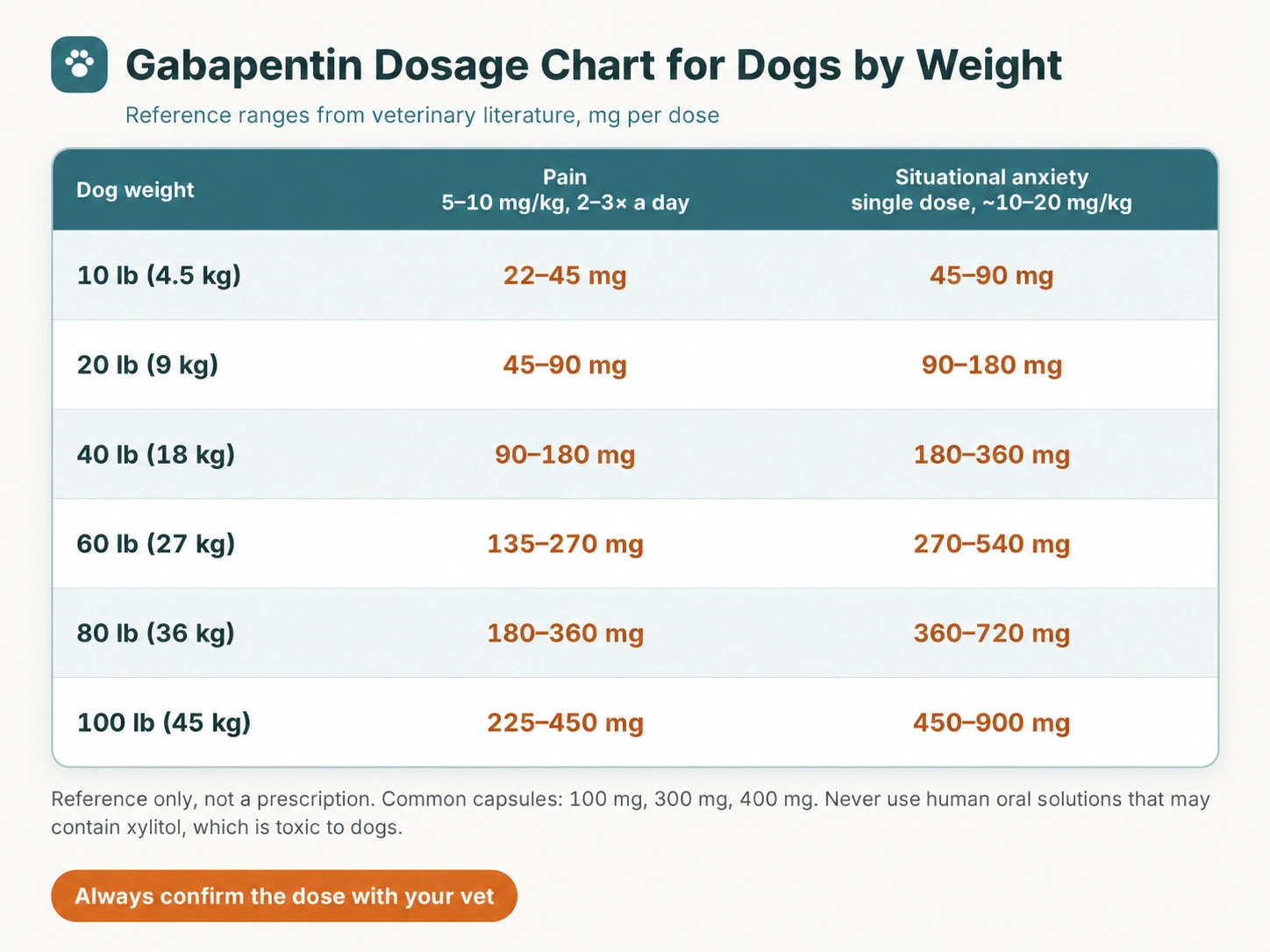
Gabapentin dose ranges for dogs by weight in pounds and kg, including 100 and 300 mg capsule counts, plus a calculator. Confirm with your vet.
Your results
Live — updates as you change inputs.
Start with your pet’s details.
Enter dog weight.
Gabapentin dose for dogs by weight (lb and kg)
Dog's weight
Pain, per dose (5–10 mg/kg)
100 mg capsules
300 mg capsules
10 lb (4.5 kg)
22–45 mg
0.25–0.5
<¼–0.25
20 lb (9 kg)
45–90 mg
0.5–1
0.25–0.25
40 lb (18 kg)
90–180 mg
1–1.75
0.25–0.5
60 lb (27 kg)
135–270 mg
1.25–2.75
0.5–1
80 lb (36 kg)
180–360 mg
1.75–3.5
0.5–1.25
100 lb (45 kg)
225–450 mg
2.25–4.5
0.75–1.5
Usually given 2–3 times daily. Kidney function changes the dose, and liquid forms can contain xylitol. Reference ranges from the calculator below, not a prescription. Always confirm the dose with your vet.
Confirm with your vet before giving this medicine. The table multiplies the labeled milligrams per kilogram by body weight. It is not a prescription and it does not replace the label.
Gabapentin has become one of the most widely used adjunct medications in veterinary practice, prescribed for chronic pain (especially nerve-related pain), as an anti-anxiety aid for situational stress like vet visits, and sometimes alongside other pain medications for a combined effect. Commonly cited dosing ranges in veterinary literature run roughly 5-10 mg/kg for pain management (often given 2-3 times daily) and can run higher for pre-visit situational anxiety as a single dose — but the wide use of this drug doesn't mean dosing is one-size-fits-all; your vet's specific prescription accounts for your dog's exact condition, other medications, and kidney function (since gabapentin is cleared renally).
How to use this calculator
Enter your dog's weight and choose the purpose — pain management or situational anxiety — since the two use different dosing conventions. The calculator returns a reference range, not a single number, because vets titrate gabapentin based on individual response.
These ranges reflect commonly cited veterinary literature, not your dog's specific prescription — capsule sizes (100 mg, 300 mg, 400 mg are common) rarely divide evenly, so your vet's actual number will usually round to the nearest practical capsule or compounded dose.
Understanding your results
The calculator's output is a range, not a target — where your dog should land inside that range depends on factors the math alone can't capture: how sedated is too sedated for this specific dog, whether it's being combined with another pain medication (common — see the NSAID/gabapentin combination FAQ below), and current kidney function, since gabapentin is cleared renally and reduced clearance means the same mg/kg dose sits in the bloodstream longer. If your vet's prescribed number falls outside the calculator's range, that's not necessarily wrong — it likely reflects one of these individual factors.
Why the pain and anxiety doses look so different. Chronic pain management calls for a lower, steady dose given multiple times a day to maintain a consistent effect. Situational anxiety calls for a single higher dose timed before the trigger, since the goal is peak sedation at a known moment rather than round-the-clock coverage — the two protocols aren't interchangeable even though they use the same drug.
What "titration" actually looks like in practice. Many vets start a new gabapentin prescription at the lower end of the relevant range and reassess after a few days to a week, adjusting upward if the effect is too mild or downward if sedation is excessive. If your dog's dose has changed since the first prescription, that's this normal adjustment process, not an error.
Signs the dose may need adjusting. Excessive stumbling, unusual grogginess lasting well beyond the expected window, or minimal effect on pain/anxiety symptoms are all worth reporting back to your vet — dosing adjustments are routine and expected, not a sign something went wrong with the original prescription.
Living with the sedation
Drowsiness is the most common side effect, especially in the first week or two or after a dose change. Time doses around walks and mealtimes where your vet's spacing allows, and expect a groggy few hours after a situational anxiety dose. Call your vet if your dog is stumbling or much sleepier than they described.
Gabapentin alongside other pain medicines
Gabapentin works on nerve pain through a different route than an NSAID such as meloxicam, so vets often add it to an anti-inflammatory rather than replace it. If your dog has two pain medicines, ask your vet why that combination was chosen.
When to consult a professional
For health, dosage, or nutrition decisions, always confirm calculator output with your veterinarian. This tool provides reference estimates, not medical advice.
Emergency or unsure?
Call your vet or ASPCA Animal Poison Control — available 24/7.
Why is gabapentin used for so many different purposes in dogs?
It affects nerve signaling in a way that's useful both for pain (especially chronic or nerve-related pain) and for reducing anxiety, which is why vets prescribe it across a fairly wide range of situations.
Is gabapentin sedating?
It commonly causes some drowsiness, especially at higher single doses used for situational anxiety (like before a vet visit) — this is often an intentional, expected effect rather than a side effect to be concerned about.
Does kidney function matter for gabapentin dosing?
Yes — gabapentin is cleared primarily through the kidneys, so dogs with reduced kidney function typically need adjusted (often lower) doses, which is something only your vet can properly assess and account for.
Can gabapentin be combined with other pain medications like meloxicam?
Often yes, as they work through different mechanisms and are commonly prescribed together for a combined pain-management effect — but always under specific vet guidance rather than combined independently.
Is gabapentin the human medication or a different veterinary formulation?
It's the same active compound used in humans, though veterinary formulations and dosing differ significantly — never substitute a human prescription without explicit vet guidance, and check that any liquid formulation doesn't contain xylitol, which is toxic to dogs and present in some human gabapentin oral solutions.
How long does a single dose of gabapentin last in dogs?
Effects commonly last around 6–8 hours per dose, though individual variation exists — this is part of why chronic pain protocols typically dose 2–3 times daily rather than once.
Can I stop gabapentin abruptly if my dog seems fine?
For short-term or single-dose situational use, yes. For dogs on a sustained daily protocol, ask your vet before stopping — abrupt discontinuation after extended use has been associated with rebound anxiety or discomfort in some cases, so a gradual taper is sometimes recommended.
What should I do if my dog misses a dose?
Give it as soon as you remember unless it's close to the next scheduled dose, in which case skip the missed one rather than doubling up — check with your vet's specific instructions for your dog's protocol, since this can vary by use case.
Does food affect how gabapentin works?
It can be given with or without food, though giving it with a small meal or treat can reduce mild stomach upset some dogs experience, without meaningfully changing its effectiveness.
Is gabapentin safe for long-term daily use?
It's commonly used long-term for chronic pain conditions under ongoing veterinary supervision, with periodic monitoring of response and, in dogs with reduced kidney function, kidney values — long-term use itself isn't inherently unsafe, but it should be monitored rather than set-and-forget.
How much gabapentin for a 50 lb dog?
At the common 5–10 mg/kg reference range, a 50 lb (22.7 kg) dog works out to about 115–225 mg per dose. Your vet sets the actual dose and how often to give it.
Is gabapentin for dogs the same as for humans?
It is the same drug, and vets often prescribe human capsules. Avoid human liquids unless your vet confirms they are xylitol-free.
Gabapentin for dogs dosage chart in kg and lb
Veterinary references such as Plumb's commonly cite about 5–10 mg per kg every 8–12 hours for chronic pain, and vets often go higher for a single dose before a vet visit. Here is that range worked out by weight. This is not a prescription. Your vet sets the dose and how often to give it, often starting low and increasing.
Dog's weight
5 mg/kg
10 mg/kg
Common capsule match
5 kg (11 lb)
25 mg
50 mg
ask your vet about a smaller tablet or a xylitol-free liquid
10 kg (22 lb)
50 mg
100 mg
1 × 100 mg
15 kg (33 lb)
75 mg
150 mg
1 × 100 mg
20 kg (44 lb)
100 mg
200 mg
1–2 × 100 mg
30 kg (66 lb)
150 mg
300 mg
1 × 300 mg
40 kg (88 lb)
200 mg
400 mg
1 × 300 mg or 1 × 400 mg
What a 100 mg or 300 mg capsule covers
100 mg sits in the 5–10 mg/kg range for a dog of about 10–20 kg (22–44 lb).
300 mg sits in the 5–10 mg/kg range for a dog of about 30–60 kg (66–132 lb).
Never use the human oral solution
Some human gabapentin oral solutions contain xylitol, which is toxic to dogs. If your dog needs a liquid, your vet will prescribe or have a pharmacy compound a xylitol-free one. If your dog has eaten something with xylitol, use the xylitol toxicity calculator and call your vet straight away.
Gabapentin with trazodone
For vet visits, vets often pair gabapentin with trazodone to calm a dog before the appointment. Both cause sleepiness, so the combined dose is lower than either drug alone would suggest. Only use the combination your vet prescribes.
References: Plumb's Veterinary Drug Handbook; Merck Veterinary Manual.
Gabapentin dosage for a 50 lb or 80 lb dog
Using the 5–10 mg/kg reference range for pain:
Dog
Weight in kg
5–10 mg/kg works out to
50 lb
22.7 kg
about 115–225 mg
80 lb
36.3 kg
about 180–365 mg
That is about 2.3–4.5 mg per pound. Vets round to a capsule size and may prescribe a different dose.
Gabapentin for anxiety, sedation or pain
Pain (arthritis, nerve pain): usually given every 8–12 hours, often started low and increased.
Anxiety before vet visits or travel: often a single dose given about 2 hours before the event. Vets sometimes prescribe a higher one-off dose for this than for daily pain control.
Sedation: sleepiness and wobbliness are the main side effects, so start on a quiet day.
Gabapentin dose for dogs vs humans: it is the same medicine. Human capsules are often prescribed for dogs, but the dose is worked out by your dog's weight, and human oral solutions may contain xylitol.
How we calculate
The math, openly documented.
Inputs
Weight, use case, and product strength where relevant.
The 7-year rule was never based on biology. Learn the DNA methylation formula vets now use to convert your dog or cat's age into accurate human-year equivalents — adjusted for breed size and life stage.
Poinsettias are usually only mildly irritating to pets, but other holiday plants are far worse. Here is which plants to keep, which to move, and what to do if your pet chews one.
 PetCalcStudio