Prednisone Dosage for Dogs, By Weight and Condition
Pet calculator
Prednisone Dosage for Dogs, By Weight and Condition
Prednisone dose ranges for dogs by weight and condition, shown as a mg chart in lb and kg, with a calculator. Always follow your vet's prescription.
Your results
Live — updates as you change inputs.
Start with your pet’s details.
Enter dog weight.
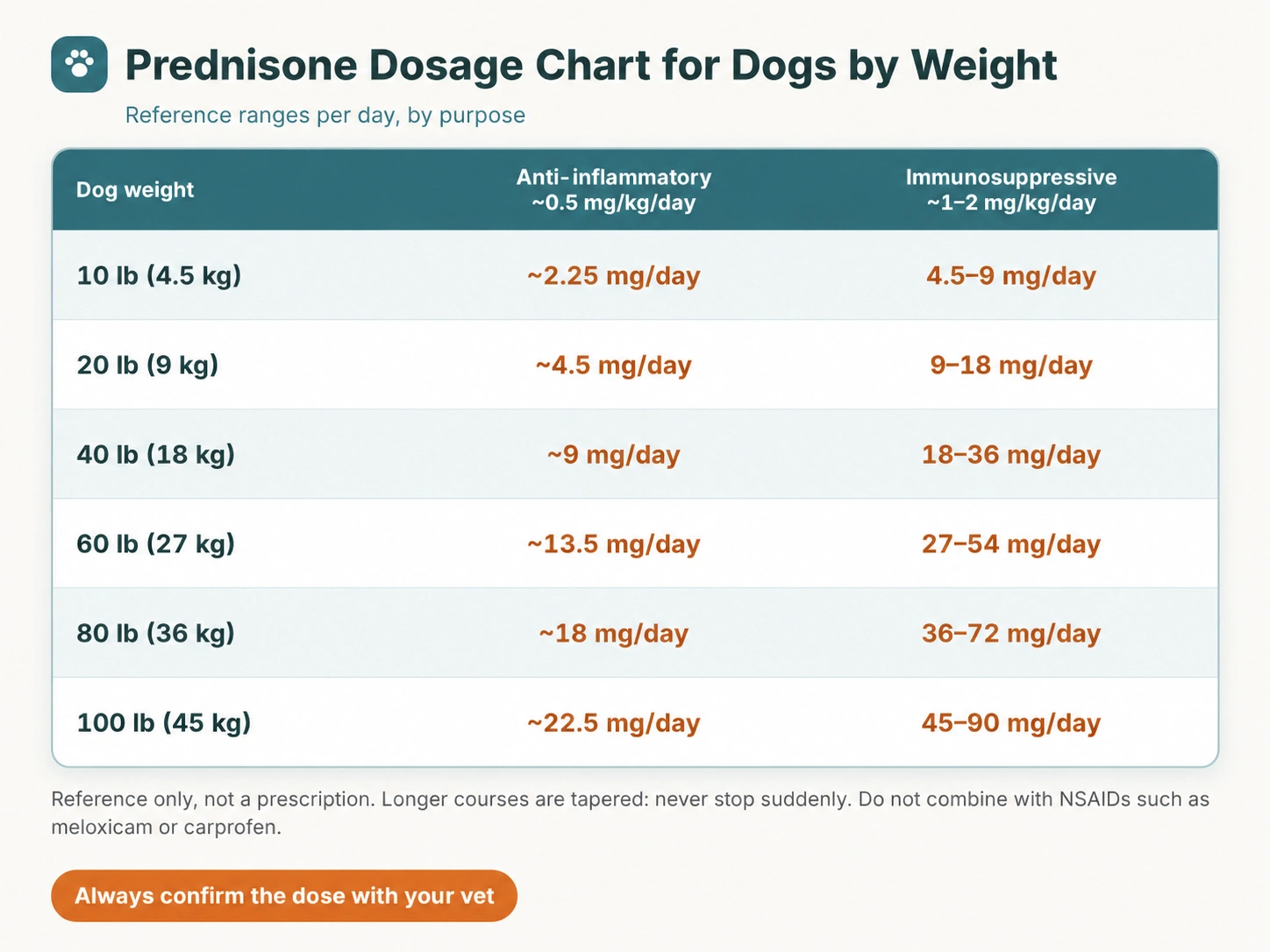
Prednisone dose for dogs by weight and use (mg per day)
Dog's weight
Anti-inflammatory (~0.5 mg/kg/day)
Immunosuppressive (~1–2 mg/kg/day)
10 lb (4.5 kg)
~2.25 mg/day
4.5–9 mg/day
20 lb (9 kg)
~4.5 mg/day
9–18 mg/day
40 lb (18 kg)
~9 mg/day
18–36 mg/day
60 lb (27 kg)
~13.5 mg/day
27–54 mg/day
80 lb (36 kg)
~18 mg/day
36–72 mg/day
100 lb (45 kg)
~22.5 mg/day
45–90 mg/day
Prednisone is tapered, never stopped suddenly after long use. Reference ranges from the calculator below, not a prescription. Always confirm the dose with your vet.
Prednisone Dosage for Dogs, By Weight and Condition
Prednisone dosing in dogs isn't one number — anti-inflammatory use (allergies, mild inflammation) typically calls for a lower dose than immunosuppressive use (autoimmune conditions), commonly cited in veterinary references as roughly 0.5 mg/kg/day for anti-inflammatory effect versus 1-2 mg/kg/day or higher for immunosuppression, and both are usually followed by a gradual tapering schedule rather than an abrupt stop. Abruptly stopping prednisone after extended use can cause adrenal insufficiency, since long-term steroid use suppresses the body's natural cortisol production — which is why "just stop when symptoms improve" is specifically not how this medication is meant to be used.
How to use this calculator
Enter your dog's weight and select anti-inflammatory or immunosuppressive use — the two protocols run at meaningfully different doses, so picking the right one matters more than the weight input alone.
Reference dosing by weight
Dog weight
Anti-inflammatory (~0.5 mg/kg/day)
Immunosuppressive (~1–2 mg/kg/day)
10 lb (4.5 kg)
~2.25 mg/day
4.5–9 mg/day
20 lb (9 kg)
~4.5 mg/day
9–18 mg/day
40 lb (18 kg)
~9 mg/day
18–36 mg/day
60 lb (27 kg)
~13.5 mg/day
27–54 mg/day
80 lb (36 kg)
~18 mg/day
36–72 mg/day
100 lb (45 kg)
~22.5 mg/day
45–90 mg/day
Prednisone tablets commonly come in 5 mg, 10 mg, and 20 mg strengths, so real prescriptions round to whatever combination gets closest to the target — don't expect an exact match to these figures.
Understanding your results and the taper
The number the calculator returns is a starting dose, not a fixed daily amount for the length of treatment. Standard veterinary practice tapers prednisone downward over days to weeks once the underlying condition is controlled — stopping abruptly after more than a few days of use risks adrenal insufficiency, because the body's own cortisol production is suppressed while an external steroid is on board. A typical taper might step down by roughly 25–50% every 1–2 weeks, but the exact schedule depends on the condition being treated, how your dog responds, and how long treatment has run — this is one of the areas where following your vet's specific written taper matters more than any general chart.
A sample taper shape (illustrative only, not a prescription). A dog started on immunosuppressive dosing for several weeks might see something like: full dose for 1–2 weeks, then roughly half that dose for 1–2 weeks, then a lower maintenance or every-other-day dose, tapering toward discontinuation over a period of weeks to months depending on the condition. Every real taper is written by the prescribing vet for that specific case — this shape exists only to illustrate why prednisone treatment has a beginning, middle, and end rather than a flat daily number.
Short courses are different from long courses. A brief course of a few days for mild inflammation generally doesn't require the same careful tapering as weeks-to-months of immunosuppressive treatment, since adrenal suppression builds with duration. Your vet's taper instructions (or lack of one, for a short course) reflect this distinction.
Managing side effects during treatment
Expect increased thirst, urination and appetite at typical doses. Offer fresh water at all times, allow more bathroom breaks (including at night), and measure meals so weight does not creep up. Call your vet about vomiting, black stools, severe lethargy or panting that is out of the ordinary.
When to consult a professional
For health, dosage, or nutrition decisions, always confirm calculator output with your veterinarian. This tool provides reference estimates, not medical advice.
Emergency or unsure?
Call your vet or ASPCA Animal Poison Control — available 24/7.
Why does prednisone dosing vary so much depending on what it's for?
Anti-inflammatory and immunosuppressive effects require different dose ranges — a dose that calms mild allergy inflammation is well below what's needed to suppress an overactive immune response in autoimmune disease.
Why can't I just stop giving prednisone once my dog seems better?
Extended steroid use suppresses natural cortisol production; stopping abruptly can trigger adrenal insufficiency, which is why vets prescribe a gradual tapering schedule rather than an on/off protocol.
What side effects should I watch for?
Increased thirst, urination, and appetite are common and expected at typical doses; more concerning signs include vomiting, black stool, or significant lethargy, which warrant a call to your vet.
Can prednisone be combined with NSAIDs like meloxicam?
Generally no, without specific vet guidance — combining steroids and NSAIDs significantly raises the risk of GI ulceration; always tell your vet about all current medications.
How long does a typical prednisone taper take?
It varies widely by condition and treatment length — a short anti-inflammatory course may taper over 1–2 weeks, while a longer immunosuppressive course can taper over several weeks to a few months. Your vet's written schedule is specific to your dog's case.
What happens if a dose is missed during a taper?
Give it as soon as you remember unless it's near the next scheduled dose; don't double up. If more than one dose is missed during an active taper, call your vet rather than guessing how to adjust the schedule.
Does prednisone affect blood sugar or appetite?
Yes — increased appetite, thirst, and urination are common and expected side effects at typical doses, and blood sugar can rise, which matters more for dogs with diabetes or pre-diabetic tendencies. Your vet may monitor this during longer courses.
Can prednisone be given with food?
Generally yes, and it's often recommended to reduce stomach upset, though follow your vet's specific instructions since some protocols specify otherwise.
Is prednisone the same as prednisolone?
They're closely related corticosteroids; prednisone converts to prednisolone in the liver to become active, which is why prednisolone is sometimes prescribed directly for dogs with liver function concerns, where that conversion step may be less reliable.
Does long-term prednisone use require ongoing bloodwork?
Yes, commonly — vets typically monitor kidney values, liver enzymes, and sometimes blood sugar during extended courses, since steroid use can affect all three over time, especially at higher immunosuppressive doses.
Is prednisolone the same as prednisone for dogs?
They are closely related. Dogs convert prednisone into prednisolone, so vets often prescribe the two at similar doses for dogs. Cats need prednisolone.
Can I give prednisone to a dog with lymphoma before seeing an oncologist?
Ask first. Prednisone alone can make lymphoma resistant to later chemotherapy, so a vet or oncologist should decide when to start it.
Prednisone for dogs dosage chart by weight and purpose
The dose depends on what it's treating. Veterinary references such as the Merck Veterinary Manual describe roughly:
Anti-inflammatory (allergies, itch): about 0.5–1 mg/kg per day
Immunosuppressive (immune-mediated disease): about 2 mg/kg per day, often split into two doses, then tapered
Dog's weight
Anti-inflammatory 0.5–1 mg/kg/day
Immunosuppressive ~2 mg/kg/day
10 lb (4.5 kg)
2.3–4.5 mg
9 mg
20 lb (9.1 kg)
4.5–9 mg
18 mg
40 lb (18.2 kg)
9–18 mg
36 mg
60 lb (27.3 kg)
14–27 mg
55 mg
80 lb (36.4 kg)
18–36 mg
73 mg
100 lb (45.5 kg)
23–46 mg
91 mg
Using 20 mg tablets
One 20 mg tablet a day falls within the anti-inflammatory range for a dog of about 20–40 kg (44–88 lb). Most tablets have a score line and can be split in half. Your vet will usually lower the dose step by step over the following weeks.
Prednisone for lymphoma
Prednisone is part of most canine lymphoma protocols (for example CHOP-based chemotherapy). In cancer protocols the dose is usually worked out from body surface area (mg/m²), not body weight, and it changes week to week. A weight-based calculator can't give you a lymphoma dose. Use the schedule from your vet or veterinary oncologist.
Never combine with NSAIDs
Giving prednisone together with an NSAID such as meloxicam or carprofen greatly raises the risk of stomach ulcers. Vets usually wait several days between switching one for the other.
Prednisone for dogs: how many days?
Course length depends on the reason. A short anti-inflammatory course may last a few days to a couple of weeks. Courses longer than about two weeks are usually tapered over days to weeks, so the adrenal glands can restart. Never stop a long course suddenly; follow your vet's taper sheet.
Prednisone vs prednisolone for dogs
Dogs convert prednisone to prednisolone in the liver, so vets often use the two at similar doses for dogs. Cats and dogs with liver disease are usually given prednisolone directly. A "prednisolone 5 mg for dogs" prescription is therefore common, especially in the UK.
Prednisone for dogs with cancer
In lymphoma and some other cancers, prednisone is used alone or as part of chemotherapy. These doses and schedules are set by your vet or a veterinary oncologist. Prednisone alone can shrink lymphoma for a while, but it can make later chemotherapy less effective, so ask before starting it.
To save the chart for later, use your browser's print or save-as-PDF option on this page.
How we calculate
The math, openly documented.
Inputs
Weight, use case, and product strength where relevant.
The 7-year rule was never based on biology. Learn the DNA methylation formula vets now use to convert your dog or cat's age into accurate human-year equivalents — adjusted for breed size and life stage.
Poinsettias are usually only mildly irritating to pets, but other holiday plants are far worse. Here is which plants to keep, which to move, and what to do if your pet chews one.
 PetCalcStudio