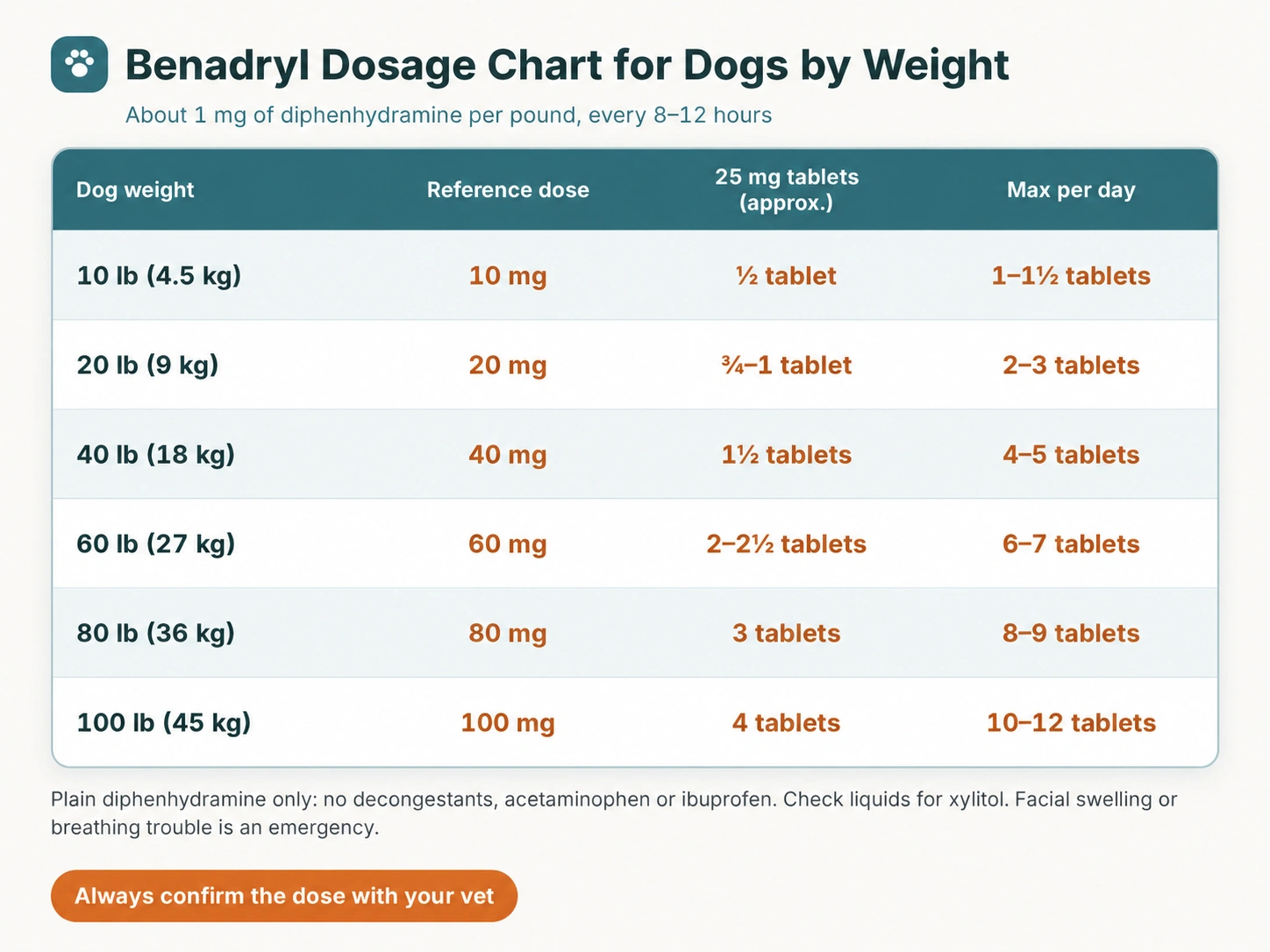
How much Benadryl can your dog have? The usual 1 mg per lb guideline as a weight chart with tablet counts, plus when not to give it.
Your results
Live — updates as you change inputs.
Start with your pet’s details.
Enter dog weight.
Benadryl dose for dogs by weight (about 1 mg per lb)
Dog's weight
Reference dose
25 mg tablets (approx.)
Max per day
10 lb (4.5 kg)
10 mg
½ tablet
1–1½ tablets
20 lb (9 kg)
20 mg
¾–1 tablet
2–3 tablets
40 lb (18 kg)
40 mg
1½ tablets
4–5 tablets
60 lb (27 kg)
60 mg
2–2½ tablets
6–7 tablets
80 lb (36 kg)
80 mg
3 tablets
8–9 tablets
100 lb (45 kg)
100 mg
4 tablets
10–12 tablets
Every 8–12 hours (2–3 times a day). Use plain diphenhydramine only, with no decongestant or xylitol. Reference ranges from the calculator below, not a prescription. Always confirm the dose with your vet.
Weight and dose reference
Confirm with your vet before giving this medicine. The table multiplies the labeled milligrams per kilogram by body weight. It is not a prescription and it does not replace the label.
Veterinary references commonly cite diphenhydramine at about 1 mg per pound of body weight, given every 8–12 hours (up to 2–3 times daily). That translates to roughly 2.2 mg/kg. The calculator above applies this math to your dog's weight and converts the result into standard tablet sizes — but your vet may adjust the dose for puppies, seniors, brachycephalic breeds, or dogs on other medications.
How to use this calculator
Enter your dog's weight in pounds or kilograms
Select the tablet strength you have on hand (25 mg is most common)
Read the highlighted dose row — this is a reference range, not a prescription
Quick reference chart (25 mg tablets)
Dog weight
Reference dose
25 mg tablets (approx.)
Max per day*
10 lb (4.5 kg)
10 mg
½ tablet
1–1½ tablets
20 lb (9 kg)
20 mg
¾–1 tablet
2–3 tablets
40 lb (18 kg)
40 mg
1½ tablets
4–5 tablets
60 lb (27 kg)
60 mg
2–2½ tablets
6–7 tablets
80 lb (36 kg)
80 mg
3 tablets
8–9 tablets
100 lb (45 kg)
100 mg
4 tablets
10–12 tablets
*Reference only — confirm with your veterinarian before first use.
Check the label before you dose
Danger: Only use plain diphenhydramine — no decongestants (phenylephrine, pseudoephedrine), no acetaminophen, no ibuprofen. "Extra strength," "Allergy + Sinus," and "Multi-symptom" human formulas often contain ingredients toxic to dogs.
When to call your vet instead
Facial swelling, difficulty breathing, repeated vomiting, collapse, or a reaction that worsens after dosing needs immediate veterinary care — Benadryl is for mild reactions, not emergencies.
Understanding your results
Why the max-per-day column runs higher than one dose × 3. The max daily figure reflects some flexibility for splitting doses across the day rather than a strict single-dose-times-frequency multiplication — always confirm the specific daily ceiling with your vet rather than assuming you can freely stack toward the top of that range.
Liquid children's Benadryl needs its own math, not a tablet substitution. Liquid concentration (commonly 12.5 mg per 5 mL) is different from tablet strength, and kitchen spoons aren't accurate measuring tools — use an oral syringe and calculate the volume from the concentration on the label, not a tablet-equivalent guess.
Common situations Benadryl is used for
Insect stings and bites with local swelling and no facial swelling or breathing trouble.
Mild vaccine reactions such as slight facial puffiness or hives. Call your vet's office first, because timing matters.
Occasional seasonal itching or watery eyes. Ongoing allergies need a longer-term plan from your vet.
Storing Benadryl safely
Keep tablets in the original labelled container so the strength and expiry date stay visible, and out of reach of every pet in the house. For liquid, check the concentration on that bottle each time, because it can differ between products.
Yes, many vets recommend diphenhydramine for mild allergic itching or hives at the 1 mg/lb reference dose. If itching persists beyond 48 hours or worsens, schedule a vet visit — underlying causes (food allergy, flea dermatitis, infection) need diagnosis, not just symptom control.
How often can I give Benadryl?
The standard reference is every 8–12 hours, up to 2–3 times per day depending on your vet's guidance. Do not exceed the daily maximum without veterinary approval.
Is children's Benadryl safe for dogs?
Only if it contains **plain diphenhydramine** with no added medications. Liquid formulations vary in concentration — use the calculator's mg dose, not teaspoon estimates, and confirm the label with your vet.
What if my dog ate too much Benadryl?
Overdose signs include extreme sedation, rapid heart rate, dilated pupils, and agitation. Contact your vet or an animal poison control line immediately if you suspect an overdose.
Can Benadryl be used for travel anxiety instead of a vet-prescribed sedative?
It's sometimes used off-label for mild travel sedation at the standard reference dose, but it's much less predictable and effective than purpose-prescribed anxiety medications (like trazodone) for dogs with genuine travel anxiety — discuss with your vet if mild sedation alone isn't enough.
How long does Benadryl take to work in dogs?
Effects typically begin within 30-60 minutes of an oral dose, which is worth planning around if timing it before a known trigger (a vet visit, a car ride, or known allergy exposure).
Is there a difference between Benadryl and generic diphenhydramine?
No meaningful difference — Benadryl is a brand name for diphenhydramine, and generic/store-brand plain diphenhydramine works identically at the same dose, often at a lower cost.
Can Benadryl be given long-term for chronic allergies?
It's more commonly used for acute or intermittent symptoms; for chronic ongoing allergies, your vet may recommend a different long-term management approach (dietary changes, allergy testing, or a different medication) rather than daily antihistamine use indefinitely.
Does Benadryl interact with other medications?
It can have additive sedating effects when combined with other sedatives or CNS-depressant medications — always share your dog's full medication list with your vet, especially before combining with anything else that causes drowsiness.
Can Benadryl cause the opposite effect — hyperactivity instead of sedation?
In a small number of dogs, antihistamines can cause paradoxical excitement rather than sedation — if your dog seems unusually wired rather than drowsy after a dose, mention it to your vet, since it may mean a different medication is a better fit for that individual dog.
Is there a maximum number of days I should give Benadryl in a row?
For acute reactions, short-term use (days, not weeks) is typical; if symptoms persist beyond a few days despite consistent dosing, that's a signal to see your vet rather than continuing indefinitely, since ongoing symptoms may need a different treatment approach or diagnosis.
Does dog size or breed change how Benadryl is metabolized?
The reference dose scales by weight, which accounts for most of the size-related difference — individual metabolism can still vary somewhat, which is part of why starting at the standard reference dose and monitoring response (rather than assuming a fixed universal effect) is the recommended approach.
How many ml of children's Benadryl can I give my dog?
Children's liquid is usually 12.5 mg per 5 mL. At the 1 mg per pound guide, that is about 0.4 mL per pound. Make sure the liquid has no xylitol, alcohol or decongestants, and check with your vet.
Can I give my dog Benadryl for a bee sting?
It may help mild swelling. If your dog has facial swelling, widespread hives, vomiting, weakness or trouble breathing, go to a vet straight away.
Benadryl dosage for dogs by weight: 1 mg per pound
The Merck Veterinary Manual and most vets use about 1 mg of diphenhydramine per pound (2 mg/kg) every 8–12 hours. Here it is by weight with plain 25 mg tablets:
Dog's weight
Dose (≈1 mg/lb)
25 mg tablets
Children's liquid (12.5 mg / 5 mL)
10 lb
10 mg
about ½
4 mL
25 lb
25 mg
1
10 mL
40 lb
40 mg
1½
16 mL
50 lb
50 mg
2
20 mL
80 lb
80 mg
3 (75 mg)
not practical
100 lb
100 mg
4
not practical
How much Benadryl for an 80 lb dog?
About 80 mg. Three 25 mg tablets (75 mg) is the closest whole-tablet dose, given no more than every 8 hours. Check with your vet first if your dog has glaucoma, heart disease, high blood pressure or is pregnant.
The two label checks that matter most
Diphenhydramine must be the only active ingredient. "Benadryl Allergy Plus Congestion" and similar products contain phenylephrine or pseudoephedrine, which can be dangerous for dogs.
Check liquids for xylitol. Some children's liquids and melt-away tablets are sweetened with it. Use the xylitol toxicity calculator if your dog swallowed a product containing it.
When Benadryl isn't the right tool
Benadryl is a mild antihistamine. Ongoing itch usually needs a vet-prescribed medicine such as Apoquel. Facial swelling, hives with vomiting, or any trouble breathing is an emergency, so go to a vet straight away instead of dosing at home.
Liquid Benadryl for dogs: how many ml?
Children's liquid diphenhydramine is usually 12.5 mg per 5 mL (2.5 mg per mL). At the common 1 mg per pound guide, that is about 0.4 mL per pound: a 20 lb dog would need about 8 mL. Check the label: some liquids contain xylitol (toxic to dogs) or alcohol, and combination products may contain decongestants that are dangerous for dogs.
Benadryl for dogs: allergies, bee stings and car rides
Allergies and itching: may help mild itch. For ongoing allergies, ask about vet medicines.
Bee stings: may help mild swelling. Facial swelling, hives all over, vomiting, weakness or breathing trouble is an emergency: go straight to a vet.
Car rides: some vets suggest it for mild motion sickness or anxiety, but it doesn't work for every dog. Approved anti-nausea medicines exist; ask your vet.
The 7-year rule was never based on biology. Learn the DNA methylation formula vets now use to convert your dog or cat's age into accurate human-year equivalents — adjusted for breed size and life stage.
Poinsettias are usually only mildly irritating to pets, but other holiday plants are far worse. Here is which plants to keep, which to move, and what to do if your pet chews one.
 PetCalcStudio