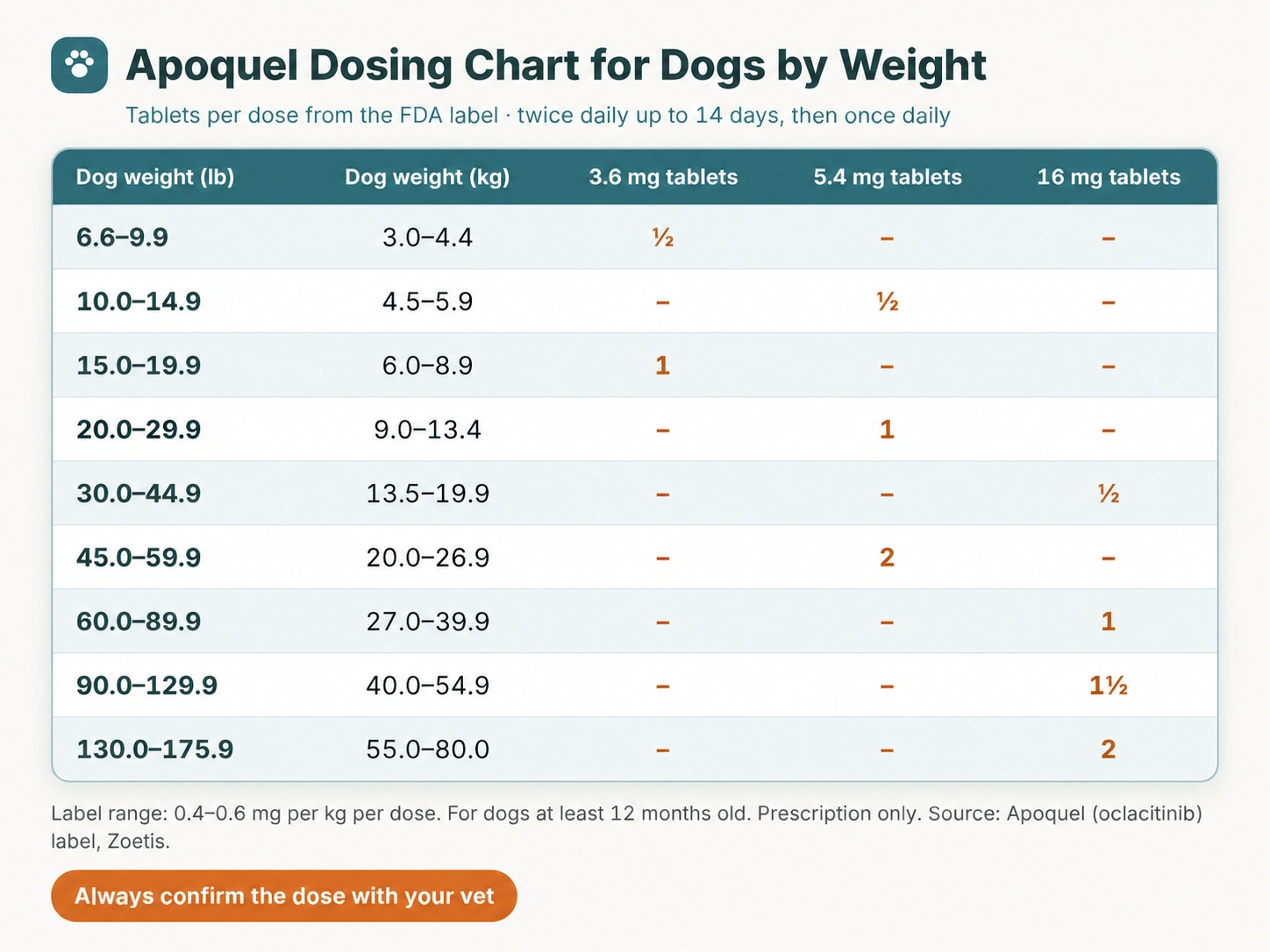
Apoquel dose chart by your dog's weight in lb and kg, with tablet sizes (3.6, 5.4, 16 mg) and a calculator. Always confirm the dose with your vet.
Your results
Live — updates as you change inputs.
Apoquel (oclacitinib) label reference
7.3–10.9 mg (0.4–0.6 mg/kg)
Label dose per administration
ScheduleTwice daily for up to 14 days, then once daily maintenance
Tablet strength selected16 mg — match your prescribed tablet
Label chart tablets per dose½ × 16 mg tablet (see the dosing chart below)
Prescription only. Tell your vet about infections, tumours, or other medicines.
Not evaluated for breeding, pregnant or lactating dogs per product labeling/VCA cautions.
Apoquel dose by weight (lb and kg)
Dog's weight
Label dose per administration
Label chart tablets
10 lb (4.5 kg)
1.8–2.7 mg
½ × 3.6 mg tablet
20 lb (9.1 kg)
3.6–5.4 mg
1 × 3.6 mg tablet
30 lb (13.6 kg)
5.4–8.2 mg
1 × 5.4 mg tablet
50 lb (22.7 kg)
9.1–13.6 mg
2 × 5.4 mg tablets
70 lb (31.8 kg)
12.7–19.1 mg
1 × 16 mg tablet
90 lb (40.8 kg)
16.3–24.5 mg
1 × 16 mg tablet
0.4–0.6 mg/kg twice daily for up to 14 days, then once daily; not for dogs under 12 months. Reference ranges from the calculator below, not a prescription. Always confirm the dose with your vet.
Weight and dose reference
Confirm with your vet before giving this medicine. The table multiplies the labeled milligrams per kilogram by body weight. It is not a prescription and it does not replace the label.
oclacitinib (Apoquel)
twice daily up to 14 days, then once daily; dogs >=12 months
oclacitinib (Apoquel) dose by weight
Weight
Dose
11 lb (5 kg)
2–3 mg
22 lb (10 kg)
4–6 mg
33 lb (15 kg)
6–9 mg
44 lb (20 kg)
8–12 mg
55 lb (25 kg)
10–15 mg
66 lb (30 kg)
12–18 mg
88 lb (40 kg)
16–24 mg
110 lb (50 kg)
20–30 mg
Label text: “0.4 to 0.6 mg oclacitinib/kg”. Source
What the Apoquel label says for dogs
Apoquel (oclacitinib) is a prescription medicine for controlling itch and allergic dermatitis in dogs at least 12 months old. The FDA labeling uses 0.4 to 0.6 mg per kg per dose, twice daily for up to 14 days, then once daily for maintenance at the same dose range. The calculator above converts your dog's weight into the label range and the label chart tablet count, and the dosing chart below lists every weight band.
This page is a label-range reference for understanding a prescription. It is not a reason to start the drug without a vet's diagnosis. Itch can come from fleas, infections, food reactions or other skin conditions, and Apoquel is only one part of a plan. Your vet should rule those out before choosing a long-term approach.
Apoquel dosing chart by weight
This is the dosing chart printed on the FDA-approved Apoquel (oclacitinib) tablet label. The number of tablets applies to each dose: twice daily for up to 14 days, then once daily for maintenance.
Dog weight (lb)
Dog weight (kg)
3.6 mg tablets
5.4 mg tablets
16 mg tablets
6.6–9.9
3.0–4.4
½
–
–
10.0–14.9
4.5–5.9
–
½
–
15.0–19.9
6.0–8.9
1
–
–
20.0–29.9
9.0–13.4
–
1
–
30.0–44.9
13.5–19.9
–
–
½
45.0–59.9
20.0–26.9
–
2
–
60.0–89.9
27.0–39.9
–
–
1
90.0–129.9
40.0–54.9
–
–
1½
130.0–175.9
55.0–80.0
–
–
2
Source: Apoquel (oclacitinib maleate) tablets prescribing information, Zoetis, as published on DailyMed. The label covers dogs of at least 12 months of age. The chewable tablet has its own chart, so check the product your vet prescribed.
Vet disclaimer: this chart is a reference for understanding a prescription, not a dosing instruction. Apoquel is a prescription medicine. Your vet decides whether it suits your dog and which tablet strength and schedule to use. Never start, stop or change the dose on your own.
Worked example: a 50 lb dog
A 50 lb dog weighs about 22.7 kg. The label range is 0.4 × 22.7 = about 9 mg per dose at the low end, and 0.6 × 22.7 = about 14 mg per dose at the high end. On the label chart above, a 50 lb dog (45.0–59.9 lb) takes two 5.4 mg tablets, or 10.8 mg, per dose, which sits inside that 9 to 14 mg range. Your vet confirms the strength and the number of tablets.
The label describes two phases. The first is twice daily for up to two weeks. The second is once daily for maintenance. A prescription that matches that structure is the standard pattern. If your vet has chosen a different plan, ask them to explain the difference.
A 20 lb (9.1 kg) dog at the same mg/kg range would be about 3.6 to 5.4 mg per dose, which again shows why weight drives the arithmetic.
What the calculator does not tell you
Whether Apoquel is the right drug for your dog's itch, which requires a diagnosis.
How long before improvement to expect. Many dogs respond within days, but the full effect varies from dog to dog.
Whether your dog can have vaccines or other medicines at the same time. Ask your vet about timing before any vaccine or lab test.
Whether the dog needs other treatment for flea control, infection or diet, which often matter as much as the tablet.
Before you start
Your vet will usually check for fleas, mites, and bacterial or yeast infections before starting Apoquel. They may ask about diet, flea control, previous treatments and how long the itch has been going on. If your dog has an infection, treating it first often gives better results.
Tell your vet about every medicine and supplement, and about any history of cancer, infection or vaccination reactions. The label gives specific cautions, and your vet is the right person to weigh them against your dog's history.
Side effects to watch for
The label and published studies report vomiting, diarrhoea, lethargy, changes in appetite, and increased thirst and urination. These are worth a call to the vet, especially if they persist beyond the first days.
Apoquel reduces part of the immune response, so the label warns about infections and about lymph node enlargement or unusual lumps. Contact your vet if your dog develops fever, a new skin infection, swollen lymph nodes, or any lump that does not go away.
Ask your vet whether they want bloodwork before starting and at follow-up visits, since the monitoring plan depends on your dog's history.
Stopping and restarting
Do not stop or change the dose without talking to your vet, because itch can return quickly. If you miss a dose, give it when you remember unless it is close to the next one. Do not double the next dose. If the itch returns after stopping, the vet may want to look again at the underlying cause rather than simply restarting the same plan.
Itch from other causes
Itch is a symptom with many possible causes. Fleas are the most common cause and must be controlled for any itch treatment to work. Bacterial or yeast infections often need their own treatment. Food reactions and environmental allergies can be managed with diet trials or allergy testing. A vet can help sort these out, and the answer changes the medicine you need.
Storage and handling
Store tablets in their original labelled container, out of reach of children and other pets. Wash your hands after handling the tablets, and keep them away from food preparation areas. If a tablet is accidentally swallowed by a person, contact a doctor or poison centre.
For a 50 lb (22.7 kg) dog, the label range is 0.4 to 0.6 mg per kg per dose, which works out to roughly 9 to 14 mg per dose. Tablets come in several strengths, so your vet will choose the strength and the number of tablets. Use the calculator for the range, then follow your vet's written directions.
How long does Apoquel take to work in dogs?
Many dogs show improvement within a few days, but the full effect can take longer, and it varies. The label describes the twice-daily phase for up to 14 days before maintenance. If your dog is not improving by the time your vet expected, call them rather than changing the dose yourself.
Can Apoquel make dogs sleepy?
Lethargy is one of the reported side effects, so sleepiness is possible. If your dog seems unusually tired, or is too sleepy to eat or move around normally, call your vet. Do not assume it is normal without checking.
Can Apoquel cause diarrhoea in dogs?
Yes. Diarrhoea and vomiting are among the more common side effects. Mild, short-lived digestive upset can happen, especially at the start. Call your vet if it is severe, lasts more than a day, includes blood, or comes with lethargy or dehydration.
Is Apoquel safe for puppies?
The label is for dogs at least 12 months old, so Apoquel is not labelled for younger puppies. If your puppy has severe itch, ask your vet about other options.
Can I give my dog Apoquel and Benadryl together?
Only if your vet has said so. Benadryl is an antihistamine with its own dose rules and side effects. Your vet should decide which itch treatments to combine, based on the diagnosis and your dog's health.
Does Apoquel cure allergies?
No. It controls itch and inflammation while the dog is on it, but it does not cure allergies. When the medicine is stopped, the itch can return. The long-term plan usually includes flea control, managing infections and, where needed, identifying and avoiding the allergen.
What should I do if my dog gets an infection while on Apoquel?
Call your vet. Because Apoquel can reduce part of the immune response, infections can become more serious. A vet will examine the dog, may take a sample for testing, and will decide whether the medicine should be paused while the infection is treated.
How much Apoquel for an 80 lb dog?
The label chart lists one 16 mg tablet per dose for dogs of 60–89.9 lb. That is given twice a day for up to 14 days, then once a day.
Can cats take Apoquel?
Apoquel is not approved for cats. Some vets prescribe it off-label at a different dose, so don't use the dog chart for a cat.
Apoquel dosing chart in kg: the mg/kg math
If you think in kilograms, this table shows the label dose range of 0.4–0.6 mg per kg per dose worked out in milligrams. Your vet then picks the nearest tablet combination from the label chart above (3.6 mg, 5.4 mg and 16 mg tablets).
Dog's weight
Label range per dose
Example tablet combination within range
5 kg (11 lb)
2.0–3.0 mg
½ of a 5.4 mg
10 kg (22 lb)
4.0–6.0 mg
1 × 5.4 mg
15 kg (33 lb)
6.0–9.0 mg
1½ × 5.4 mg
20 kg (44 lb)
8.0–12.0 mg
½ of a 16 mg
30 kg (66 lb)
12.0–18.0 mg
1 × 16 mg
40 kg (88 lb)
16.0–24.0 mg
1 × 16 mg
50 kg (110 lb)
20.0–30.0 mg
1½ × 16 mg
Always check the tablet count against the printed label chart, which is the dosing authority. The schedule is twice daily for up to 14 days, then once daily. Don't keep giving the twice-daily dose long-term unless your vet tells you to.
Who should not take Apoquel
According to the FDA-approved label, Apoquel is not for dogs under 12 months old or dogs with serious infections. It may make existing parasitic skin infections or cancers worse. Tell your vet if your dog is pregnant, nursing or used for breeding, or is on other immune-suppressing drugs such as prednisone.
From the label chart (0.18–0.27 mg per pound per dose):
Dog
Label tablet
10 lb
½ × 5.4 mg tablet
55 lb
2 × 5.4 mg tablets
80 lb
1 × 16 mg tablet
Given twice a day for up to 14 days, then once a day.
Apoquel dosing chart for cats
Apoquel is not approved for cats. Some vets use it off-label at different doses, so never use the dog chart for a cat.
How many Apoquel a day?
Once your dog is past the first 14 days, the label dose is once a day. Giving it twice a day long-term is outside the label and should only happen if your vet says so.
How we calculate
The math, openly documented.
Inputs
Weight, use case, and product strength where relevant.
The 7-year rule was never based on biology. Learn the DNA methylation formula vets now use to convert your dog or cat's age into accurate human-year equivalents — adjusted for breed size and life stage.
Poinsettias are usually only mildly irritating to pets, but other holiday plants are far worse. Here is which plants to keep, which to move, and what to do if your pet chews one.
 PetCalcStudio