 PetCalcStudio

How to Feed Dogs and Cats Separately in a Shared Home
Set up separate feeding stations, measure each pet’s meals and monitor what they actually eat with a simple household routine.
3 min readCare guide
Build a measured puppy meal routine with examples for three or four meals, clear daily-versus-meal portions and guidance on when to ask your veterinary team.
Educational information. Updated . Our editorial policy
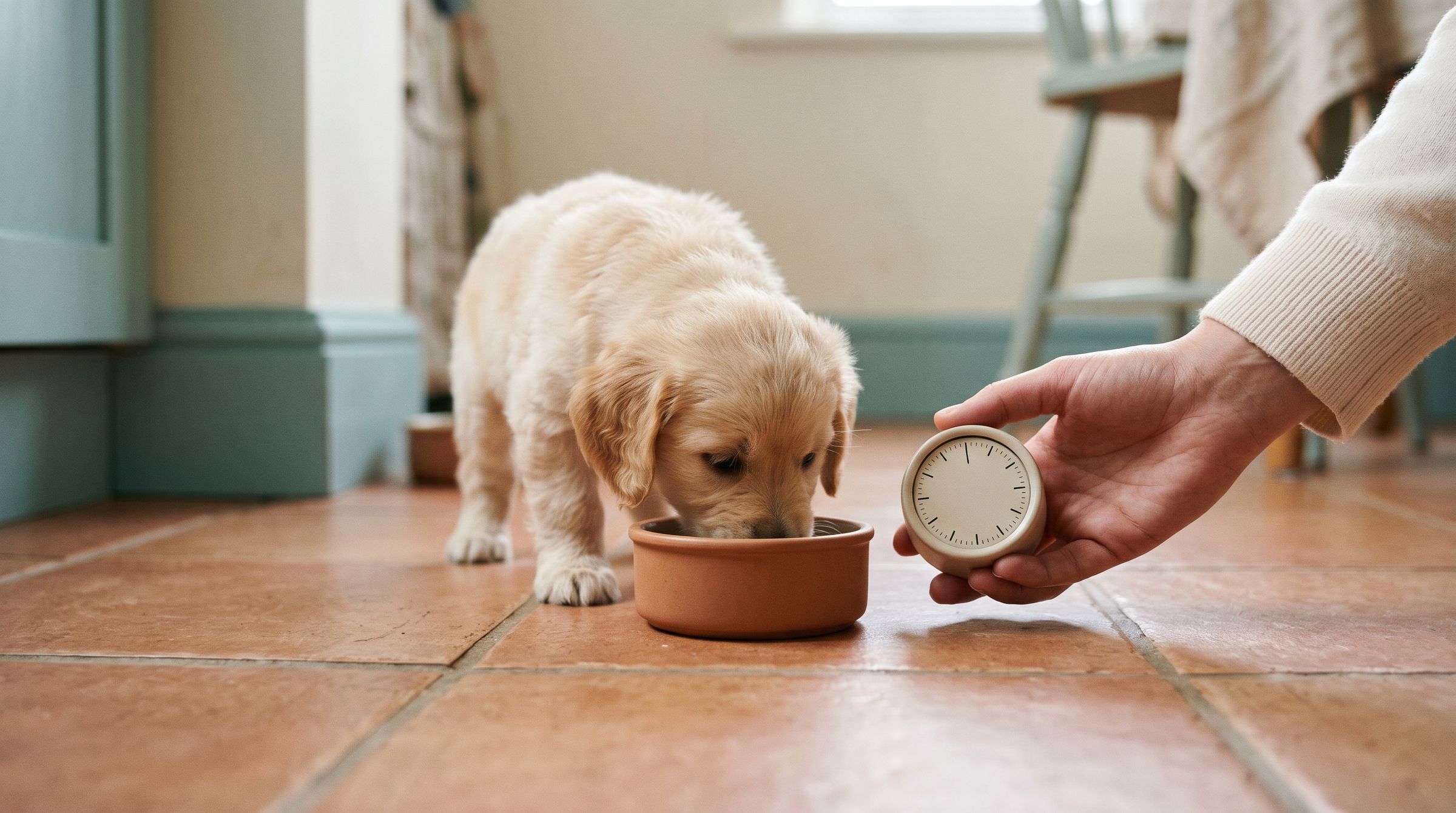
Choose an appropriate daily amount first, then divide it into meals. A schedule should make feeding consistent without turning an age chart into a prescription. This guide concerns weaned puppies eating puppy food; newborn or hand-reared puppies need a different veterinary plan.
VCA describes three or four smaller meals as helpful for a puppy’s small stomach. Its small-dog guidance recommends at least three small meals for puppies under four months. The right transition to fewer meals depends on growth, size and individual needs, not a birthday alone.
| Pattern | Example routine | How to divide the daily amount |
|---|---|---|
| Four meals | Morning, late morning, afternoon, evening | One quarter at each meal if divided equally |
| Three meals | Morning, afternoon, evening | One third at each meal if divided equally |
| Two meals when appropriate | Morning and evening | One half at each meal if divided equally |
These are household planning examples, not instructions to fast a puppy overnight for a specified number of hours. Ask your veterinary team about a routine for a very small puppy, a puppy with poor appetite, or one with health concerns.
Suppose your puppy’s established plan supplies 180 g of a particular food each day. Three equal meals would be 60 g each. Four equal meals would be 45 g each. Neither example tells you whether 180 g is appropriate for your puppy.
If you reserve some of that same food for training, measure the daily total first. For example, reserving 12 g from a hypothetical 180 g daily amount leaves 168 g for meals: 56 g at each of three meals. Do not add the training portion on top by accident.
Choose a food labeled for growth and suitable for the puppy’s expected size; ask your veterinary team about large-breed growth needs. VCA advises against adding nutritional supplements unless your veterinarian recommends them. Use a kitchen scale to measure grams rather than a loosely filled scoop.
Our cup-to-gram guide explains why scoop weights vary by recipe. The dog food calculator can help explore the inputs, but a growing puppy’s plan needs reassessment as the puppy changes.
Record the date, exact recipe, daily amount, meal pattern, food actually eaten and any concerns. Keep a separate growth record using the same scale and measurement method where practical. Bring both to veterinary visits so the discussion is based on observations rather than memory.
Use our puppy growth estimator as an estimate, not a target that the puppy must be fed to reach. If appetite, growth or general wellbeing concerns you, seek veterinary advice rather than forcing a chart’s predicted portion.
When your veterinary team recommends fewer meals, redistribute the planned daily amount and make the new routine clear to everyone feeding the puppy. Recheck your written meal note so an old serving size is not accidentally repeated at the new frequency.
Sources checked 2026-11-20. Written by Heromedia for PetCalcStudio. This is an editorial source check, not an independent veterinary review. Worked examples are illustrative and do not establish an individual pet’s needs.
Checked against the sources below by the editorial team. This is not an independent veterinary review.
Set up separate feeding stations, measure each pet’s meals and monitor what they actually eat with a simple household routine.
3 min readSet up safe storage for dry pet food and opened wet food. Keep lot codes handy and learn what to do with leftovers and damaged packaging.
3 min readConvert cups to grams using your food’s own label. See worked examples, avoid scoop errors, and measure an existing feeding plan more consistently.
3 min read
