 PetCalcStudio

How to Feed Dogs and Cats Separately in a Shared Home
Set up separate feeding stations, measure each pet’s meals and monitor what they actually eat with a simple household routine.
3 min readCare guide
Orphaned or underfed puppies need a commercial puppy milk replacer, not cow's milk. Mix it per the label, warm it to about body temperature, feed on the belly every 2-4 hours in the early weeks, and start weaning at around 3-4 weeks.
Educational information. Our editorial policy
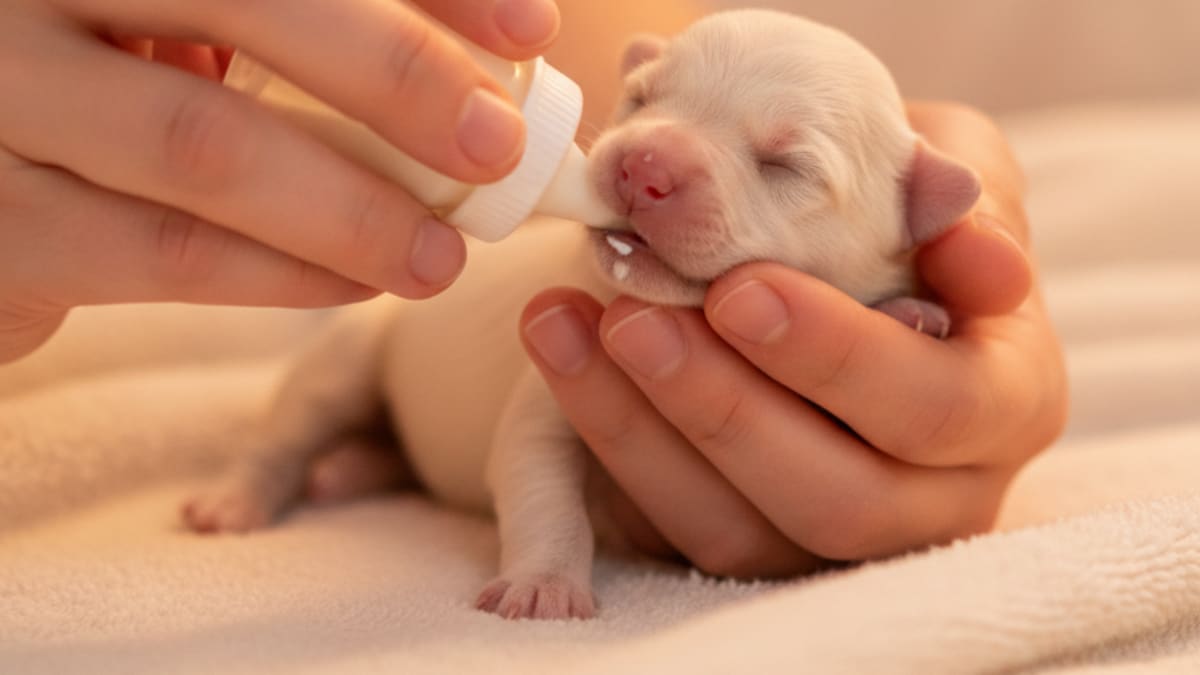
Orphaned or underfed puppies need a commercial puppy milk replacer, not cow's milk. Mix it per the label, warm it to about body temperature, feed on the belly every 2-4 hours in the early weeks and start weaning at about 3-4 weeks.
If you've got newborn puppies without a mother, or a litter that isn't gaining weight, call your vet right away. Newborns are fragile: they can't regulate their own temperature, have tiny energy reserves and can decline in hours. This guide covers why cow's milk is a poor choice, how to choose and mix formula, how to bottle-feed safely, how much and how often, toileting, warmth, weaning and the warning signs that need a vet. Weigh them daily, and use the dog food calculator by weight and age once they're eating solid food.
Even when the mother is present, a runt or weak puppy may need supplemental feeding. Ask your vet to assess.
Cow's milk has less protein and fat and more lactose than dog milk. It can cause diarrhea and dehydration in puppies. Goat's milk, plant milks, evaporated milk and home recipes aren't reliable substitutes, and some can cause harm. A commercial puppy formula is designed to mimic a bitch's milk.
Follow the tin's chart. As a typical veterinary reference, newborns need roughly 13 mL of formula per 100 g of body weight per day in week 1, rising to roughly 22 mL per 100 g by week 4.
| Age | Typical feeding frequency |
|---|---|
| Week 1 | Every 2-3 hours, including nights |
| Weeks 2-3 | Every 3-4 hours |
| Week 4 | Every 4-6 hours, with gruel introduced |
A 300 g newborn puppy in week 1.
Expect steady daily gain. A puppy that doesn't gain or loses weight needs a vet.
Newborn puppies can't regulate their body temperature. A common target is about 85-90°F (29-32°C) in the first week, reducing gradually over the following weeks. Use a heating pad on low under half the box, or a fabric-wrapped warm water bottle, so puppies can move away.
Around 3-4 weeks, offer a gruel of puppy food and formula in a shallow dish. Reduce the formula over 2-3 weeks. Most puppies are weaned by 6-8 weeks. See the dog food calculator by weight and age for portions as the puppy grows.
Call promptly if a puppy is cold, limp, isn't nursing, has diarrhea, a swollen belly, gasping, milk from the nose or isn't gaining weight.
Follow the label chart for your formula. A commonly cited guide for orphaned puppies is roughly 13 mL per 100 g of body weight per day in week 1, rising to about 17 mL in week 2 and 20 mL in week 3, split across feeds. Weigh puppies daily and ask your vet if gains stall.
Use kitten milk replacer for kittens; its nutrient balance is different. For orphaned wildlife such as squirrels, contact a licensed wildlife rehabilitator rather than using puppy formula.
General guidance on this topic from veterinary organizations. This guide is educational and written by a non-veterinarian; check with your own vet before changing your pet's food, medication or care. Editorial policy
No. It can cause diarrhea and doesn't meet a puppy's needs. Use a puppy milk replacer.
Usually every 2-3 hours in the first week, then every 3-4 hours. Follow your vet and the formula label.
No. Use a formula made for puppies.
Around 3-4 weeks, starting with gruel, and weaning is usually done by 6-8 weeks.
Follow the label. A commonly cited guide is about 13 mL per 100 g of body weight per day in the first week, increasing over the next weeks.
Not long-term. It isn't a complete puppy formula, so use it only as a short emergency stop-gap.
Set up separate feeding stations, measure each pet’s meals and monitor what they actually eat with a simple household routine.
3 min readSet up safe storage for dry pet food and opened wet food. Keep lot codes handy and learn what to do with leftovers and damaged packaging.
3 min readConvert cups to grams using your food’s own label. See worked examples, avoid scoop errors, and measure an existing feeding plan more consistently.
3 min read
