 PetCalcStudio

Senior Pet Vet Visit Checklist for Dogs and Cats
Prepare for a senior pet checkup with a simple record of mobility, appetite, weight, medications and questions for your veterinary team.
3 min readCare guide
Puppies are usually about 50–75% of their adult weight by 6 months, depending on size. Toy and small breeds finish growing around 6–12 months, and large and giant breeds keep growing until 12–24 months, so compare your puppy against its own size band.
Educational information. Our editorial policy
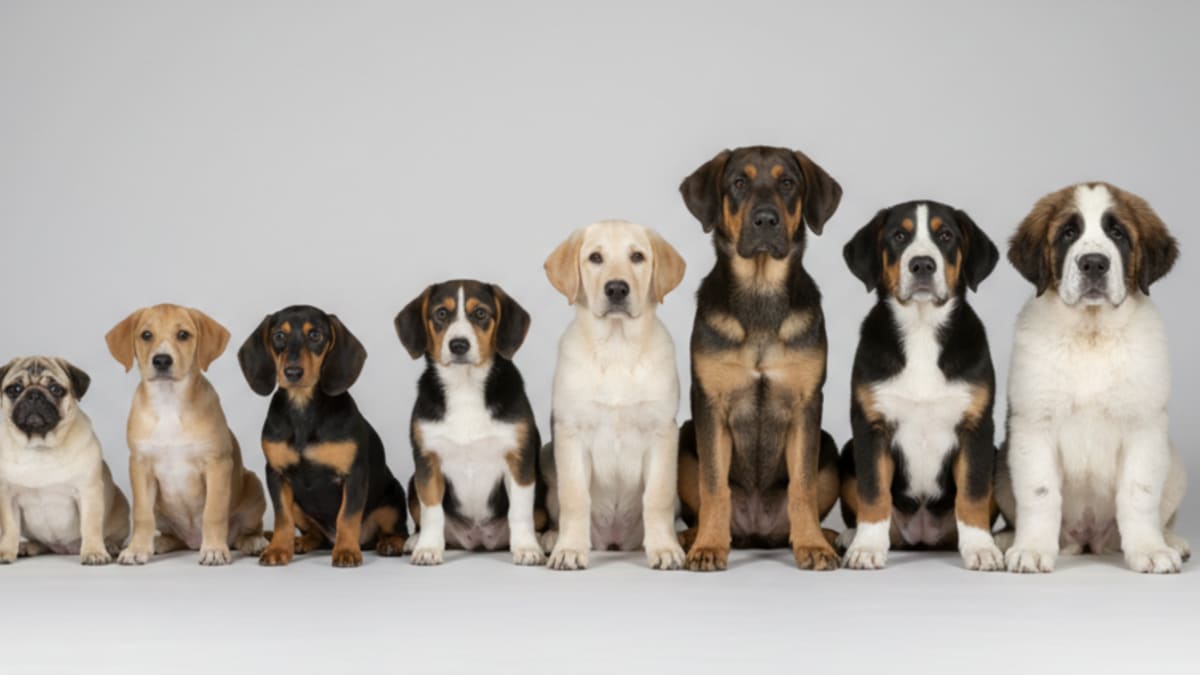
Puppies are usually about 50–75% of their adult weight by 6 months, depending on size. Toy and small breeds finish growing around 6–12 months, and large and giant breeds keep growing until 12–24 months, so compare your puppy against its own size band.
A good puppy weight chart is really a "typical range" chart. It won't tell you exactly what your puppy will weigh, but it will tell you whether you're in the ballpark. For a personal estimate, try our puppy weight predictor.
This chart uses the American Kennel Club's growth percentages for each size group and applies them to example adult weights. Your puppy's breed will differ, so swap in your own expected adult weight.
| Size group | Example adult weight | At 6 months | At 12 months |
|---|---|---|---|
| Toy / small (AKC: up to 20 lb) | 5 lb (2.3 kg) | 3.8 lb (1.7 kg) | 5 lb (2.3 kg) |
| Small | 15 lb (6.8 kg) | 11 lb (5.1 kg) | 15 lb (6.8 kg) |
| Medium (21–50 lb) | 40 lb (18 kg) | 26 lb (12 kg) | 38 lb (17 kg) |
| Large (51–100 lb) | 70 lb (32 kg) | 42 lb (19 kg) | 60 lb (27 kg) |
| Giant (100+ lb) | 120 lb (54 kg) | 60 lb (27 kg) | Still growing |
The percentages behind it, from AKC's chart:
| Size group | % of adult weight at 6 months | % at 12 months |
|---|---|---|
| Small | about 75% | about 100% |
| Medium | about 66% | about 95% |
| Large | about 60% | about 85% |
| Giant | about 50% | still growing (up to 18–24 months) |
Prefer kilograms? This chart uses the same AKC percentages as above (about 75% of adult weight at 6 months for small dogs, 66% for medium and 60% for large, and 100%, 95% and 85% at 12 months), applied to common adult weights in kg.
| Expected adult weight | Size band | At 6 months | At 12 months |
|---|---|---|---|
| {pw} |
If your puppy is a giant breed (over 45 kg or 100 lb), expect about 50% of adult weight at 6 months and growth to continue until 18–24 months.
There is no single figure because an 8-week-old Chihuahua and an 8-week-old Great Dane are very different sizes. The useful check is to weigh your puppy and use the puppy weight calculator with its breed size, then keep a weekly record. Steady gain matters more than hitting one number. See how much weight a puppy should gain per week for the trend to expect.
The idea is simple. Your puppy's weight is a percentage of what it will eventually weigh. Small puppies get there fast, and big puppies take their time.
To use it:
A 6-month-old Great Dane and a 6-month-old Chihuahua are both "6 months old," but one is about halfway done and the other is nearly finished. That's why one chart for all puppies doesn't work.
Not sure how to pick a size group? Try our dog growth calculator.
Both are large breeds, so they follow the "large" row. Adult weights vary by line, so check the AKC breed page and ask your breeder.
Those are estimates built from AKC's large-breed percentages. If you'd like a Lab-specific breakdown, see our Labrador puppy weight chart.
Per AKC's growth guide:
Height and weight don't finish together. A large-breed puppy can reach adult height at 12 months and keep filling out for another six.
Use the chart for a rough check, then use your hands.
A slightly lean puppy is healthier than a heavy one, especially in large breeds, where extra weight puts stress on growing joints. Our dog BMI calculator can add a second opinion, and our weight tracker lets you log weigh-ins so you can see the trend.
Let's check two puppies against the "large" row. Both are Golden Retriever females, expected adult weight 60 lb (27 kg). At 6 months, the large-breed target is about 60%, so about 36 lb.
Scout weighs 38 lb (17 kg) at 6 months.
Poppy weighs 50 lb (23 kg) at 6 months.
Now try your own puppy. Enter age and weight in our puppy weight predictor and compare with the chart above. For how much to gain each week, see how much weight a puppy should gain per week. If your puppy is a mix, use our mixed-breed puppy weight chart instead, and for how the estimates work under the hood, see our AKC puppy weight calculator explainer.
Contact your vet if you notice:
Small breeds (adult weight under about 20 lb) reach about half their adult weight around 3–4 months and are usually close to full size by 9–12 months. A Yorkshire Terrier, for example, is usually under about 7 lb as an adult.
To print or save this chart, use your browser's print or save-as-PDF option. Note your puppy's weight every week on the same scale.
General guidance on this topic from veterinary organizations. This guide is educational and written by a non-veterinarian; check with your own vet before changing your pet's food, medication or care. Editorial policy
It depends on breed size. One published Labrador chart puts an 8-week-old Lab at roughly 5–15 lb (2.3–6.8 kg), with males heavier than females, while toy breeds can weigh only a few pounds. Compare your puppy against its own breed's chart, and focus on steady weekly gain.
Roughly 4–6 months for most puppies, depending on size. AKC's chart shows giant breeds at about 50% at 6 months and small breeds at about 75%, so small dogs pass the halfway mark earlier than big ones.
Charts show typical ranges, and puppies vary. Genetics, sex, litter size and feeding all matter. If your puppy is active, eating well, and has a healthy body shape, being a little small is usually fine. If gain has stalled or your puppy seems weak, call your vet.
Males are usually a bit heavier at the same age, especially in larger breeds. Use the chart for your puppy's sex and breed if you can.
There is no useful single average because adult size ranges from about 2 kg (5 lb) to over 50 kg (110 lb). Compare your puppy with its own size band instead: roughly 75% of adult weight at 6 months for small dogs, 66% for medium, 60% for large and 50% for giant.
Yes. The kg chart on this page converts the AKC size-band percentages into expected weights at 6 and 12 months for adult weights from 3 kg to 45 kg.
It gives a typical range, not a promise. Individual puppies often differ by 10–15% from the chart because of genetics, nutrition and neutering timing, so use it with a body-condition check and your vet's advice.
Most small breeds are close to adult size by 9–12 months.
Prepare for a senior pet checkup with a simple record of mobility, appetite, weight, medications and questions for your veterinary team.
3 min readThe 7-year rule was never based on biology. Learn the DNA methylation formula vets now use to convert your dog or cat's age into accurate human-year equivalents — adjusted for breed size and life stage.
7 min readPoinsettias are usually only mildly irritating to pets, but other holiday plants are far worse. Here is which plants to keep, which to move, and what to do if your pet chews one.

