 PetCalcStudio

Senior Pet Vet Visit Checklist for Dogs and Cats
Prepare for a senior pet checkup with a simple record of mobility, appetite, weight, medications and questions for your veterinary team.
3 min readCare guide
Newborn puppies should gain roughly 5–10% of their body weight a day and double their birth weight in about 10 days. After weaning, weekly gain depends on expected adult size, so compare the trend against a growth curve instead of one fixed number.
Educational information. Our editorial policy
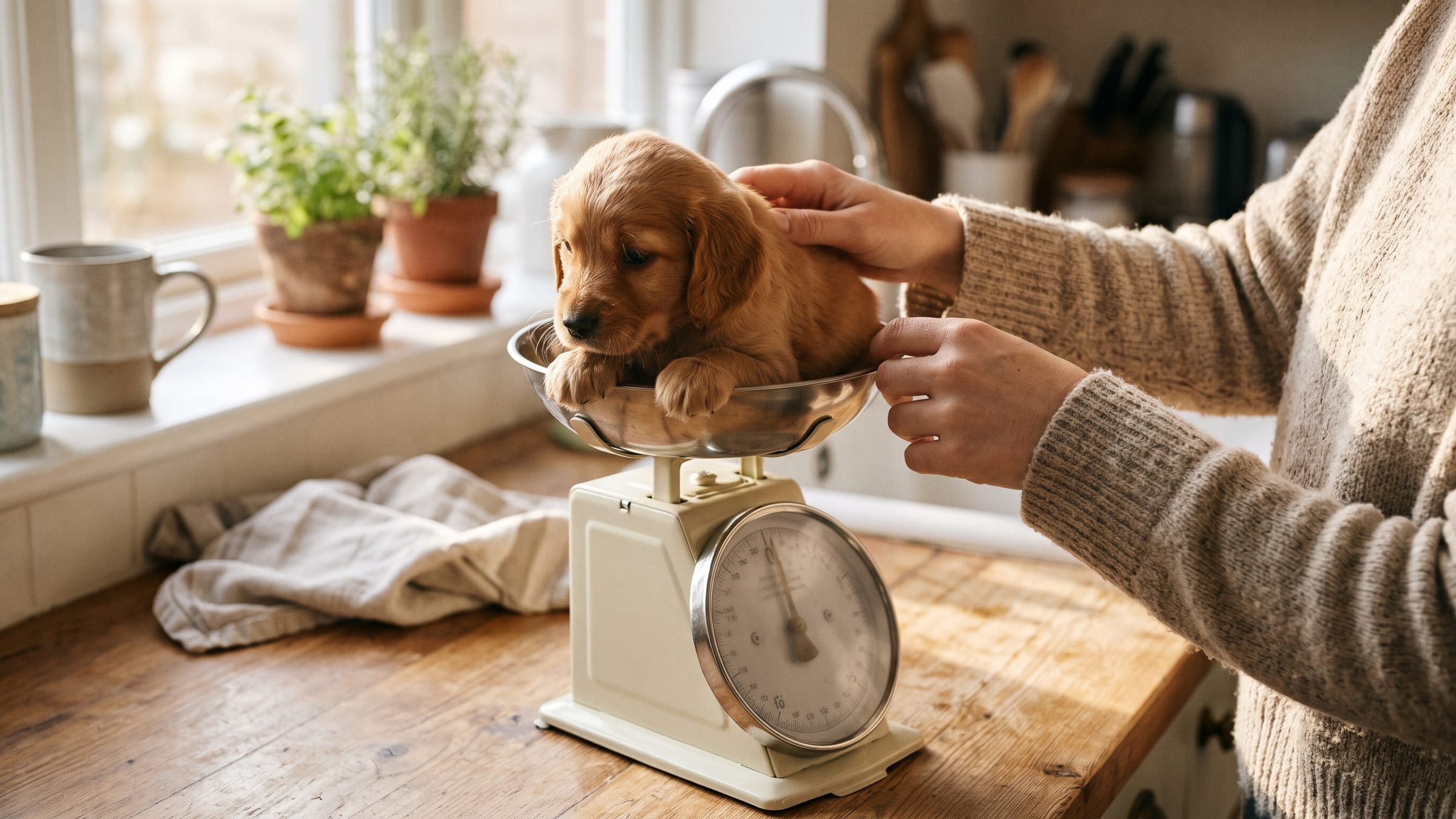
Newborn puppies should gain roughly 5–10% of their body weight a day and double their birth weight in about 10 days. After weaning, weekly gain depends on expected adult size, so compare the trend against a growth curve instead of one fixed number.
If you're weighing your puppy and wondering how much weight a puppy should gain per week, the frustrating truth is that "normal" moves as your puppy grows. A Chihuahua adds ounces and a Great Dane adds pounds. What matters is a steady upward line. To plot yours, use our puppy weight calculator.
It depends on age and size:
The rest of this page explains where those numbers come from.
Veterinary neonatal guidance, summarized by dvm360 and the Veterinary Nurse Journal, gives these rules of thumb for nursing puppies:
In the first 24 hours, a puppy may lose a few grams. After that, it should hold steady or gain, and steady daily gains should start within a day or two.
Worked example. A large-breed puppy is born at 400 g (0.9 lb).
So by day 5, this pup should be somewhere around 490–590 g. If the pup is losing weight or flat across a day or two, call the vet or the breeder's vet right away.
These numbers come from vet teaching sources, so ask your own vet if you're raising a litter. Neonatal puppies are fragile.
After weaning, puppies grow fastest. Gains per week vary a lot by breed, but here's an anchor. Using the midpoints of one published Labrador chart, a female goes from about 7.5 lb (3.4 kg) at 2 months to about 40 lb (18 kg) at 6 months, and a male goes from about 12.5 lb (5.7 kg) to about 47.5 lb (21.5 kg). That's roughly 2 lb (0.9 kg) a week.
Smaller breeds gain less, and giants gain more. Instead of a single number, use the expected adult weight to sanity-check:
Those percentages come from AKC's growth chart. For a puppy weight chart by size, see our puppy weight chart. For Lab specifics, see the Labrador puppy weight chart.
From 6 to 12 months, here's the average weekly gain computed from AKC's percentages:
| Adult size (example) | Weight at 6 months | Weight at 12 months | Average gain per week |
|---|---|---|---|
| Toy, 5 lb (2.3 kg) | 3.8 lb (1.7 kg) | 5 lb (2.3 kg) | about 0.8 oz (23 g) |
| Small, 15 lb (6.8 kg) | 11 lb (5.1 kg) | 15 lb (6.8 kg) | about 2.3 oz (65 g) |
| Medium, 40 lb (18 kg) | 26 lb (12 kg) | 38 lb (17 kg) | about 0.45 lb (0.2 kg) |
| Large, 70 lb (32 kg) | 42 lb (19 kg) | 60 lb (27 kg) | about 0.7 lb (0.3 kg) |
More adult-weight examples, using the same AKC percentages as the table above (average gain per week = (weight at 12 months − weight at 6 months) ÷ 26 weeks).
| Expected adult weight | Size band | At 6 months | At 12 months | Average gain per week |
|---|---|---|---|---|
| 10 lb (5 kg) | Small | 7.5 lb | 10.0 lb | 0.10 lb (44 g) |
| 25 lb (11 kg) | Medium | 16.5 lb | 23.8 lb | 0.28 lb (126 g) |
| 50 lb (23 kg) | Medium | 33.0 lb | 47.5 lb | 0.56 lb (253 g) |
| 60 lb (27 kg) | Large | 36.0 lb | 51.0 lb | 0.58 lb (262 g) |
| 80 lb (36 kg) | Large | 48.0 lb | 68.0 lb | 0.77 lb (349 g) |
| 100 lb (45 kg) | Large | 60.0 lb | 85.0 lb | 0.96 lb (436 g) |
Real puppies gain in spurts, so judge the trend over three to four weeks, not one weigh-in. For the 8-week to 6-month stretch, gains are larger, and about 2 lb (0.9 kg) a week is typical for a Lab-sized puppy.
Bad measurements make good puppies look like problems. A few tips:
Too slow. Watch for flat weight over two weekly weigh-ins, or any loss. Common causes: worms, poor appetite, illness, stress or not enough calories. See how to help a puppy gain weight safely, and check your puppy's food target with how much to feed a puppy by weight.
Too fast. Puppies who pack on weight rapidly, especially large and giant breeds, put extra stress on growing joints. If your pup is well above its size band and losing its waist, ask your vet to adjust portions. Overfeeding is the usual culprit.
A quick body check helps: ribs should be easy to feel but not see, and there should be a visible waist from above.
Let's use a medium-breed puppy expected to reach 40 lb (18 kg). At 6 months, AKC's medium curve says about 66%, so about 26 lb (12 kg).
Rio's weekly weights (lb): 20, 21.5, 23, 24, 25.5, 26.5.
Now try your own puppy. Enter the weights in our puppy weight calculator, and compare against a growth curve. To turn weight into meals, use the dog feeding chart by weight and age.
Call your vet if you see:
Newborn puppies should gain steadily from day 2 or 3 and roughly double their birth weight in 7–10 days. A common guide in the first weeks is about 5–10% of birth weight per day. Weigh newborns daily on a kitchen scale in grams.
It depends on adult size: toy breeds may gain only 100–200 g a week, while large breeds can gain 1–1.5 kg (2–3 lb) a week.
General guidance on this topic from veterinary organizations. This guide is educational and written by a non-veterinarian; check with your own vet before changing your pet's food, medication or care. Editorial policy
A small dip in the first 24 hours can happen. After that, newborn puppies should hold steady and then gain daily. Loss after the first day, or no gain over 24–48 hours, means calling a vet.
Daily for newborns, weekly for puppies from 8 weeks to about 6 months, and every couple of weeks after that. Consistent timing matters more than frequency.
Yes. Especially in large and giant breeds, rapid gain can stress developing joints. If your puppy is well above its size band and losing its waist, ask your vet about adjusting portions.
No. Gains bounce around a bit week to week. Look at the trend over several weeks.
A Lab-sized puppy typically gains about 0.9 kg (2 lb) a week between 2 and 6 months. From 6 to 12 months a medium breed gains roughly 0.1–0.3 kg a week and a large breed about 0.25–0.45 kg a week. Smaller breeds gain a few dozen grams a week.
It depends on adult size. A Lab-sized puppy is in its fastest-growth phase and often adds about 1–2 lb (0.5–0.9 kg) a week, while a toy breed adds a few ounces. Compare the trend against a growth curve for the expected adult size.
Weekly gains vary, so one flat week is not unusual. Two flat or falling weigh-ins in a row, or any loss, deserves a vet check for worms, illness or too few calories.
Roughly 5–10% of birth weight a day, doubling birth weight in about 7–10 days.
Prepare for a senior pet checkup with a simple record of mobility, appetite, weight, medications and questions for your veterinary team.
3 min readThe 7-year rule was never based on biology. Learn the DNA methylation formula vets now use to convert your dog or cat's age into accurate human-year equivalents — adjusted for breed size and life stage.
7 min readPoinsettias are usually only mildly irritating to pets, but other holiday plants are far worse. Here is which plants to keep, which to move, and what to do if your pet chews one.
6 min read
