 PetCalcStudio

How to Feed Dogs and Cats Separately in a Shared Home
Set up separate feeding stations, measure each pet’s meals and monitor what they actually eat with a simple household routine.
3 min readCare guide
You love your cat. That love often shows up as food. An extra scoop here. A few treats there. Leftover bits from your plate. Refilling the bowl whenever it looks empty.
Educational information. Our editorial policy
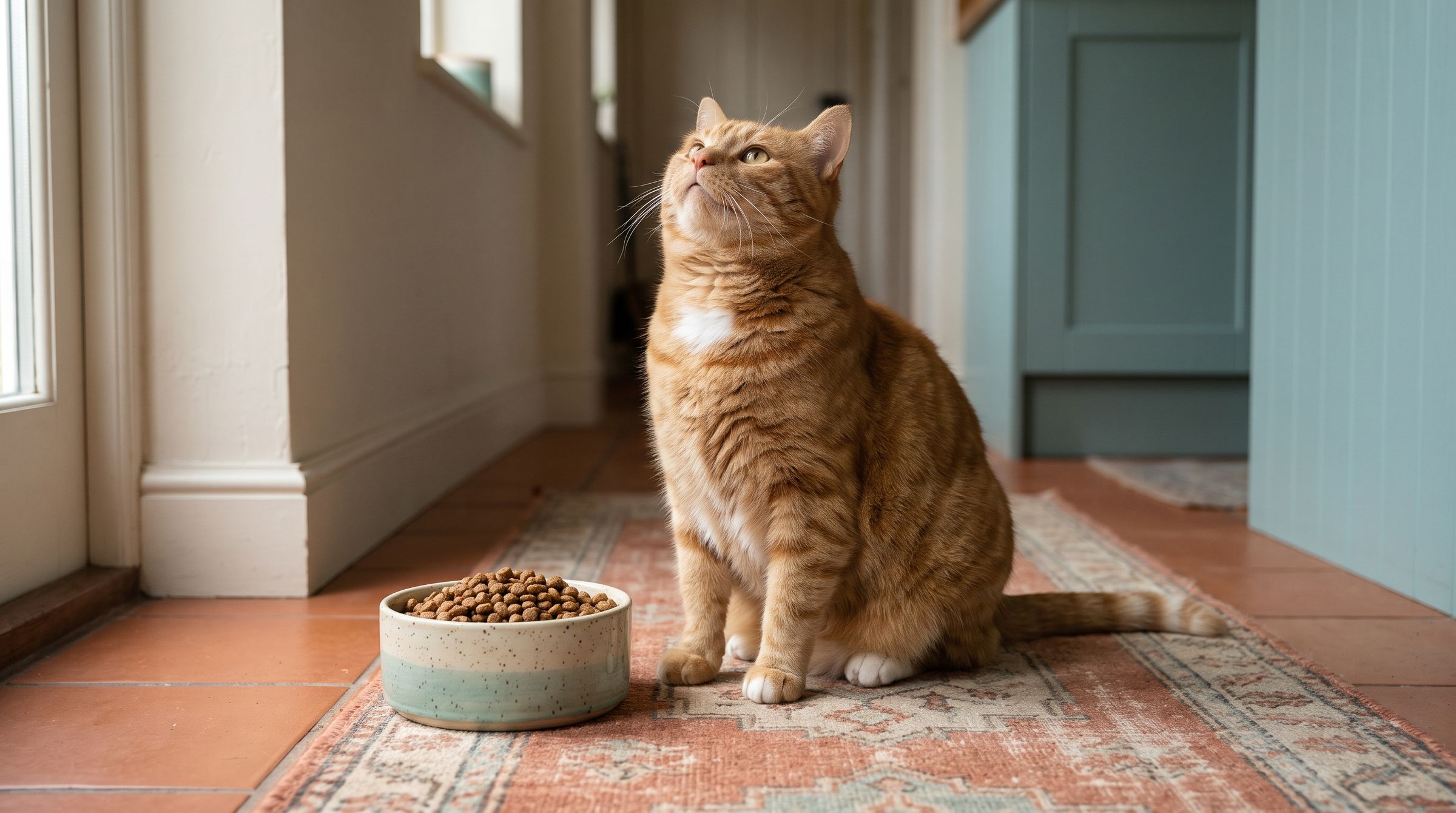
There's a specific kind of cat owner who reads articles like this. Not the ones feeding their cat fast food from the table. The ones who actually care - who buy decent food, keep vet appointments, and still somehow end up with a 14-pound cat that the vet politely describes as "a little chunky."
Overfeeding rarely looks like overfeeding. It looks like a full bowl. A second scoop because the bowl looked empty. Treats as a greeting ritual. Wet food on top of dry because the cat was vocal about it.
The problem isn't love. The problem is that cats are extraordinarily good at asking for food they don't need, and we're extraordinarily bad at saying no to them.
Here's what's actually happening inside a chronically overfed cat - and why the consequences are more serious than most owners realise until it's too late to easily reverse.
A pound of excess weight on a cat is not the same as a pound of excess weight on a human. Proportionally, it's closer to 20 pounds on an average adult person.
Obesity in cats is defined as 20% above ideal body weight. For a cat whose healthy weight is 10 pounds, that threshold is 12 pounds. Two pounds. Most owners look at a 12-pound cat and see a normal, slightly chubby cat. Clinically, that animal is obese.
The physical signs are worth knowing:
If your cat has three or more of these, the weight is already causing problems - even if bloodwork looks clean at the next vet visit.
Start measuring meals today. Not tomorrow. A kitchen scale is more accurate than a measuring cup, which can be off by 20-30% depending on how it's filled.
Feline diabetes is one of the most preventable serious diseases in domestic cats, and overfeeding - particularly carbohydrate-heavy dry food - is the most consistent driver.
When a cat eats more than it needs, especially foods high in starch and carbohydrates, the pancreas has to produce more insulin to manage blood sugar. Over months and years, that system degrades. Insulin resistance develops. Then diabetes.
The signs owners usually miss early:
Diabetic cats can go into remission with aggressive weight loss and diet change, but not all of them do. The ones that don't require twice-daily insulin injections, prescription food, and regular glucose monitoring - for the rest of their lives. The financial and time cost is significant. The earlier it's caught, the better the odds of reversal.
If your cat is overweight and showing any of the above, a veterinary blood glucose test is the right next step. Don't wait.
Arthritis in cats is underdiagnosed because cats don't limp the way dogs do. They adapt. They stop jumping to the windowsill and sleep lower. They hesitate at the stairs. They get quieter. Owners interpret this as the cat getting older or calmer. Often it's the cat managing pain.
Every excess pound adds compressive load to the hips, knees, and lumbar spine. Overweight cats develop cartilage damage years earlier than they should, and the damage is irreversible - you can manage the inflammation but you can't rebuild the cartilage.
Things to watch for that aren't obviously "arthritis":
Weight loss alone frequently resolves mild arthritis symptoms without any medication. That's not a metaphor for "try harder." It's literally the primary treatment recommendation for overweight arthritic cats.
The chain of causation here is direct: overweight cats move less -> less movement means less water intake -> concentrated urine -> crystal formation -> potential blockage.
In male cats especially, urinary crystals can aggregate into a plug that blocks the urethra completely. A blocked male cat cannot urinate. Without emergency intervention within hours, it's fatal.
Signs that something is wrong urologically:
A male cat straining to urinate with no output is not a "wait and see" situation. It is an emergency. Go immediately.
For female cats and less acute cases - any urinary symptoms warrant a vet visit within 24 hours, not next week.
This is the one that catches owners completely off guard, because it sounds backwards.
Hepatic lipidosis - fatty liver disease - doesn't happen from eating too much. It happens when an overweight cat suddenly stops eating. The body, sensing starvation, mobilises fat reserves and sends them to the liver for conversion to energy. But the feline liver isn't designed to process that volume of fat. It backs up. The liver swells with fat deposits and starts to fail.
The cruel irony: the sicker the cat gets, the less it wants to eat. The less it eats, the more fat floods the liver. The spiral is rapid.
What makes overweight cats uniquely vulnerable is that they have more fat to mobilise. A cat that skips meals for 24-48 hours because of stress, illness, a diet change, or a new pet in the house can tip into early hepatic lipidosis faster than you'd expect.
Signs to take seriously in an overweight cat:
Treatable if caught early. Requires feeding tubes and hospitalisation in severe cases. Prevention is keeping the cat at a healthy weight so that a day or two of not eating doesn't become a crisis.
An overweight cat that stops eating for more than 24 hours needs a vet. Not monitoring at home. A vet.
Chronic kidney disease is already the leading cause of death in senior cats. It's largely unavoidable as cats age. But obesity accelerates it.
Excess body fat drives systemic inflammation and sustained elevated blood pressure - both of which damage the glomeruli, the tiny filtering structures in the kidneys. The damage starts silently, years before any symptoms appear.
By the time a cat shows obvious kidney disease symptoms - drinking more, weight loss, vomiting, poor coat - kidney function is often already significantly reduced. You cannot restore lost function. You can only slow the progression.
Annual blood panels for cats over seven. Every six months for overweight cats or those with known risk factors. Blood work catches the early decline before the cat shows a single outward sign.
Most owners genuinely don't know. They fill a bowl when it empties. That's how you end up with a 14-pound cat.
General daily calorie targets for healthy indoor adult cats:
| Cat weight | Daily calories |
|---|---|
| 8-10 lbs (ideal) | 180-220 kcal |
| 10-12 lbs (borderline) | 220-260 kcal |
| Currently overweight, weight loss goal | 150-180 kcal |
These are starting points. Every cat's actual requirement depends on age, activity level, neuter status, and metabolic rate. Use the PetCalcStudio Cat Calorie Calculator to get a number specific to your cat rather than working from averages.
What matters more than the exact number: measuring every meal, removing the bowl between meals, and adjusting based on weight change over time. Weigh the cat monthly. If the number is going up on a measured diet, the measured amount is too much.
Fast weight loss in cats is dangerous for the exact reason described above - it triggers hepatic lipidosis. The target is slow, deliberate, sustained.
Safe rate: no more than 0.5-1% of body weight per week. For a 14-pound cat, that's 1-1.4 ounces per week. At that rate, reaching an ideal weight of 10 pounds takes roughly 6-9 months. That timeline is correct. Don't try to accelerate it.
The approach:
Before starting any calorie restriction, confirm with a vet that there's no thyroid or metabolic condition driving the weight. Hyperthyroidism in cats can mask as weight gain or complicate weight loss in ways that need medical management.
Always confirm significant dietary changes with your vet. Use the Cat Calorie Calculator to find a personalised daily target for your specific cat.
General guidance on this topic from veterinary organizations. This guide is educational and written by a non-veterinarian; check with your own vet before changing your pet's food, medication or care. Editorial policy
Check your cat's body condition. You should feel ribs with light pressure but not see them. Your cat should have a visible waist behind the ribs when viewed from above. If you cannot feel ribs easily, you are overfeeding.
Some cats can. Most cannot. Free feeding works for a small percentage of cats. For the majority, free feeding leads to obesity. Measure every meal.
No. Many cats beg for food constantly regardless of how much they eat. This is behavioral, not medical. Do not give in. Stick to measured portions. If you are concerned, ask your vet to rule out medical causes of increased appetite like diabetes or hyperthyroidism.
Yes. Treats should make up no more than 10 percent of daily calories. For a 200 calorie daily budget, that is only 20 calories of treats. That is about two to three small commercial cat treats. Consider using a piece of kibble as a treat instead.
Dry food is more calorie dense and easier to overfeed. A cup of dry food contains significantly more calories than a cup of wet food. Switching to wet food makes portion control easier and provides more moisture, which helps with satiety.
Measure every single meal. Throw away the scoop that came with the food bag. Use a kitchen scale or a standardized measuring cup. Feed meals at set times. Remove the bowl between meals. Your cat will adjust within two weeks.
Set up separate feeding stations, measure each pet’s meals and monitor what they actually eat with a simple household routine.
3 min readSet up safe storage for dry pet food and opened wet food. Keep lot codes handy and learn what to do with leftovers and damaged packaging.
3 min readConvert cups to grams using your food’s own label. See worked examples, avoid scoop errors, and measure an existing feeding plan more consistently.
3 min read
