 PetCalcStudio

Senior Pet Vet Visit Checklist for Dogs and Cats
Prepare for a senior pet checkup with a simple record of mobility, appetite, weight, medications and questions for your veterinary team.
3 min readCare guide
Most cats are fully grown at about 12 months, reaching adult height around then and filling out by 18 months. Large, slow-maturing breeds such as Maine Coons can keep growing until they're 3–5 years old.
Educational information. Our editorial policy
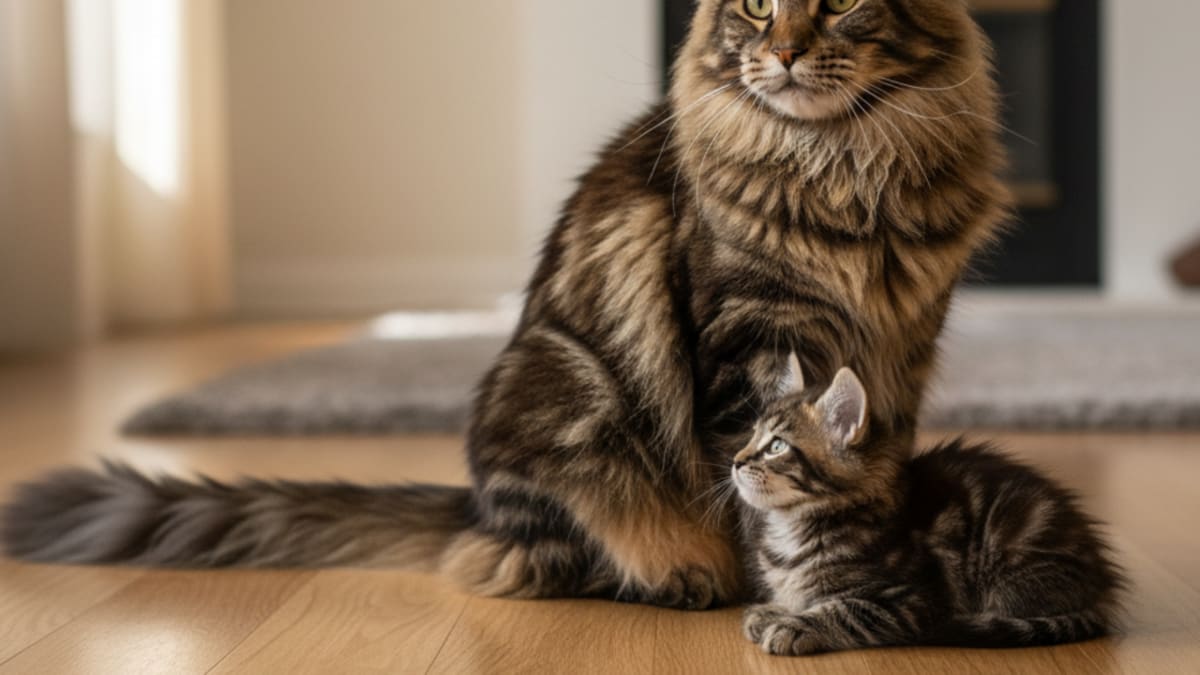
Most cats are fully grown at about 12 months, reaching adult height around then and filling out by 18 months. Large, slow-maturing breeds such as Maine Coons can keep growing until they're 3–5 years old.
So, at what age is a cat fully grown? For a typical domestic shorthair, the answer is "about a year, give or take." For a giant breed, it's more like "wait a few years." Here's how it plays out, and how to tell if your kitten still has growing to do. If you'd like to see your cat's age in human years as you read, try our cat age chart.
For most cats:
That's true for most domestic cats, which is what most of us have at home. Some finish a little sooner, some a little later. Our cat age calculator can also help you estimate what age your cat is fully grown in human terms. Keep reading for the exceptions.
| Stage | Age | What's happening |
|---|---|---|
| Newborn | 0–4 weeks | Kittens double their birth weight in about 10 days and gain roughly 10–15 g a day |
| Kitten | 1–6 months | Fast growth. A common rule of thumb is about a pound a month for the first 4 months |
| Adolescent | 6–12 months | Growth slows. Legs and body reach adult proportions |
| Young adult | 12–18 months | Height is done. Chest and muscle fill out |
| Large breeds | 18 months–5 years | Slow "filling out" continues in some breeds |
The newborn and early-kitten figures come from veterinary neonatal guidance summarized by dvm360. They're averages, so a healthy kitten can land a bit above or below.
Yes. Bigger cats need longer to build all that bone and muscle.
Maine Coons are the classic example. Breed-focused sources say they grow fast in the first year, then slow down and keep growing until about 3 to 5 years of age. Some sources note males may keep adding body depth right up to year 5. Their coat and mane also take years to fully develop.
Ragdolls and Norwegian Forest Cats are also known as slow-maturing breeds, and owners commonly report they keep filling out well past their first birthday, into their third or fourth year. There's less formal data on these, so if you have one, your breeder is the best source for what to expect.
Here's the takeaway: a Maine Coon at 18 months can look nearly full-size and still have a lot of growing to do. Don't panic if a large-breed kitten seems "small for its age" at a year. Track the trend, not just the number.
Possibly a little. Cats that are spayed or neutered very young may keep growing longer, since sex hormones help close the growth plates in the bones. The practical effect is usually small: slightly longer legs, or a slightly leaner frame. Cats altered later don't change.
Neutering also changes metabolism. Fixed cats burn fewer calories, so weight gain is common afterward. That's a feeding issue, not a growth issue. Watch portions, and see how much a 1-year-old cat should eat.
Try these checks:
A cat that keeps gaining weight after 18 months is usually gaining fat. For a body-condition check, our cat BMI calculator is a handy starting point.
You don't need fancy gear to see whether your kitten is on track:
Healthy growth is steady, with a few quick spurts. Stalls, losses or sudden jumps are worth a call to your vet. For the feeding side, our cat feeding chart shows portions by weight.
It's fun to compare growth to human milestones. A common rule: 1 year = 15 human years, 2 years = 24, and +4 for each year after.
Worked example: a Maine Coon at 3 years and at 5 years.
So a 3-to-5-year-old Maine Coon finishing its growth is roughly 28 to 36 in human terms, a "late bloomer" indeed.
Try your own cat's age in our cat age calculator, or compare species with the pet age calculator.
Growth should be steady. Call your vet if:
General guidance on this topic from veterinary organizations. This guide is educational and written by a non-veterinarian; check with your own vet before changing your pet's food, medication or care. Editorial policy
Many do, but mostly in the "filling out" sense. Height and length are usually done by 12 months, while chest and muscle keep developing until about 18 months. Large breeds like the Maine Coon can keep growing much longer.
There's no perfect predictor. Breed, parents' size, sex and nutrition all matter. Males are usually larger than females. If you know the parents' adult weights or the breed standard, use that as a rough guide, and ask your vet for a body-condition check as your kitten grows.
Most sources say between 3 and 5 years old. They grow fastest in the first year, then slow down and gradually reach full size, including a full coat and mane.
Most cats switch to adult food around 12 months. Large, slow-growing breeds sometimes stay on kitten or "all life stages" food a bit longer. Ask your vet, since the right timing depends on your cat's body condition.
Prepare for a senior pet checkup with a simple record of mobility, appetite, weight, medications and questions for your veterinary team.
3 min readThe 7-year rule was never based on biology. Learn the DNA methylation formula vets now use to convert your dog or cat's age into accurate human-year equivalents — adjusted for breed size and life stage.
7 min readPoinsettias are usually only mildly irritating to pets, but other holiday plants are far worse. Here is which plants to keep, which to move, and what to do if your pet chews one.
6 min read
