 PetCalcStudio

How to Feed Dogs and Cats Separately in a Shared Home
Set up separate feeding stations, measure each pet’s meals and monitor what they actually eat with a simple household routine.
3 min readCare guide
Fresh cat food is gently cooked, refrigerated or frozen food that can be highly palatable and moisture-rich, but it usually costs more per calorie than canned or dry. Judge it by the AAFCO statement, calories and price per day, then portion it to your cat's calorie target.
Educational information. Our editorial policy
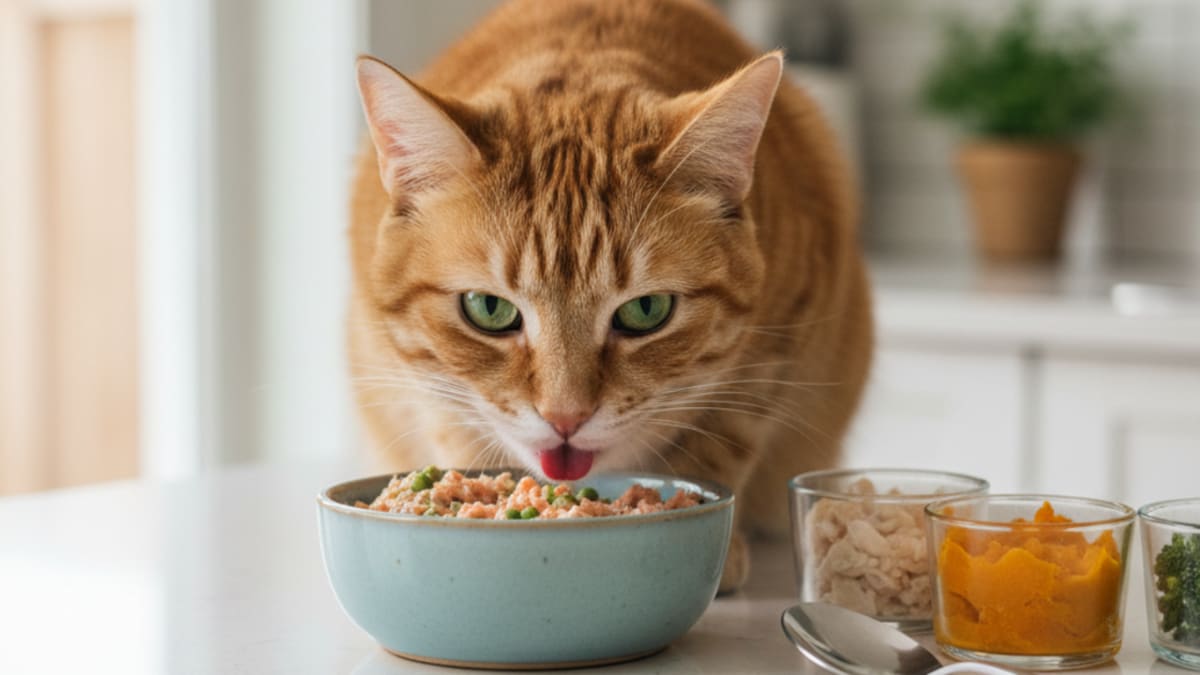
Fresh cat food is gently cooked, refrigerated or frozen food that's often very palatable and high in moisture, but it usually costs more per calorie than canned or dry food. Judge any fresh brand by its AAFCO statement, nutrition expertise, calories and cost per day, then portion it to your cat's calorie target.
Fresh food has become a popular alternative to kibble and cans, and it can be a good fit for picky eaters, cats that need more moisture and owners who want simpler ingredient lists. But "fresh" isn't a nutrition guarantee, and the cost adds up. This guide explains what fresh cat food is, the pros and cons, what to check before you buy, how to compare the cost per day, how to store and serve it safely, and how to fit it into a mixed diet. Set a calorie target with the cat food calculator.
Fresh cat foods are typically cooked at lower temperatures than canned food and sold chilled or frozen, often through subscriptions or in store refrigerators. They may contain identifiable meat, organ meat and vegetables, and many have a soft, pâté-like or shredded texture. Some are complete and balanced diets; others are toppers or are labeled for intermittent or supplemental feeding only, which is not enough to feed on its own. Always check the label.
Our guide to WSAVA dog food guidelines lists questions you can ask a cat food maker too.
The formula is simple: daily cost = (daily kcal ÷ kcal per gram) × price per gram.
A neutered 4 kg cat needs about 240 kcal a day (RER 198 × 1.2). The prices below are illustrative, so swap in the numbers from your own labels.
Fresh food: 1.3 kcal per gram, $12 per 500 g pack ($0.024 per gram).
Canned food: 80 kcal per can at $1.00 a can.
Dry food: 390 kcal per cup at $0.25 per cup.
In this example, fresh costs roughly 1.5 times canned per day. Whether it's worth it depends on your cat's appetite, your budget and how well the food meets the quality checks above.
Many owners feed fresh food as part of a mixed diet. Count the calories from every source, and adjust other foods down as you add fresh. Use the cat calorie calculator to keep the total on target, and see how much wet and dry food to feed a cat for how to split calories.
Transition gradually over 7-10 days. Cats can be stubborn about texture changes, and a cat that won't eat for more than 24 hours needs a vet check, because fasting can cause a serious liver condition (hepatic lipidosis).
Talk to your vet before switching if your cat has kidney, urinary, thyroid, diabetes or digestive problems. Call if your cat has vomiting, diarrhea, stops eating, loses weight or strains in the litter box, which is an emergency in male cats.
Not automatically. Both can be complete and balanced. Fresh often costs more and needs more careful storage.
Feed to your cat's daily calorie target using the food's kcal per gram. Use a kitchen scale for accuracy.
Only if the label says so for your cat's life stage. Some fresh products are toppers.
Follow the label. Often a few days refrigerated once opened or thawed.
Set up separate feeding stations, measure each pet’s meals and monitor what they actually eat with a simple household routine.
3 min readSet up safe storage for dry pet food and opened wet food. Keep lot codes handy and learn what to do with leftovers and damaged packaging.
3 min readConvert cups to grams using your food’s own label. See worked examples, avoid scoop errors, and measure an existing feeding plan more consistently.
3 min read
