 PetCalcStudio

How to Feed Dogs and Cats Separately in a Shared Home
Set up separate feeding stations, measure each pet’s meals and monitor what they actually eat with a simple household routine.
3 min readCare guide
Divide an established calorie allowance between wet and dry cat food using the actual label values. Includes a worked example and common portion mistakes.
Educational information. Updated . Our editorial policy
The useful answer
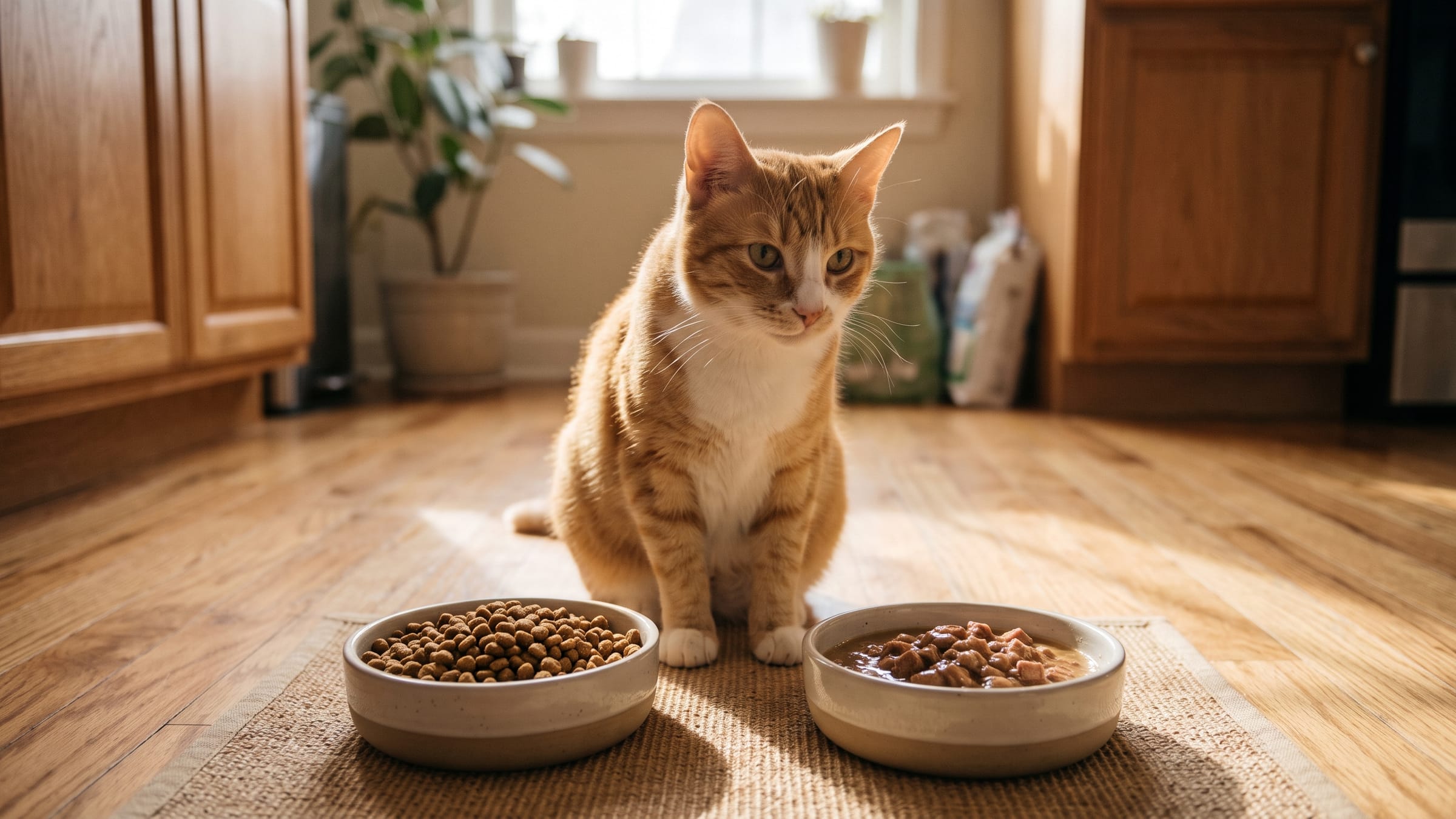
Split an established daily calorie allowance between wet and dry food using the energy values of both exact recipes. Adding a full wet-food ration to a full dry-food ration double counts the plan.
Start with one daily calorie allowance, then divide it between the two foods. Feeding the full wet-food ration plus the full dry-food ration can double-count the same meal budget. A 50/50 split means half the calories from each food, not equal weights or volumes.
Cats Protection explains that cats may eat complete wet food, dry food or a combination. Use foods suitable for the cat’s life stage. If a veterinary diet is prescribed, ask the treating team before mixing in another product.
An estimate from the cat calorie calculator is a starting point, not a measured requirement. AAHA recommends considering the individual animal and checking body weight and condition over time. Weight alone cannot establish the right allowance for every cat.
Suppose an existing plan allocates 200 kcal per day to the two main foods. For this example only, the wet food supplies 80 kcal per pouch and the dry food supplies 4 kcal per gram. Choose a 60% wet / 40% dry split for the arithmetic:
| Step | Calculation | Result |
|---|---|---|
| Wet-food energy | 200 × 0.60 | 120 kcal |
| Wet-food quantity | 120 ÷ 80 kcal/pouch | 1.5 pouches |
| Dry-food energy | 200 × 0.40 | 80 kcal |
| Dry-food quantity | 80 ÷ 4 kcal/g | 20 g |
| Cross-check | (1.5 × 80) + (20 × 4) | 200 kcal |
The split is an example, not a claim that 60/40 is healthier. If treats are part of the overall plan, the calories assigned to these main foods must already account for them. Every pouch and gram contributes to the same daily total.
Read kcal/kg, kcal/cup and kcal/can before entering label numbers. At 4,000 kcal/kg, dry food supplies 4 kcal/g. A can with 160 kcal is not interchangeable with an 80 kcal pouch: the same 120 kcal wet allocation would use 0.75 can.
For a fixed wet amount, subtract its calories from the main-food allowance. Divide the remainder by the dry food’s kcal/g. If the remainder is negative, the wet quantity already exceeds that allowance; do not interpret it as a negative dry portion.
Write down the daily wet amount and daily dry grams, then divide them into your planned meals. Avoid adding an unmeasured bowl of kibble after counting only the wet meals. In a multi-cat home, record each cat’s intended intake separately; food served to the household is not necessarily food eaten by each cat.
Recalculate when the recipe or package size changes. Discuss unexpected appetite or weight changes with your veterinary team rather than repeatedly altering the split. This worked example is not a kitten growth plan, a weight-loss prescription or a therapeutic diet.
For wet-only arithmetic, continue to cans and pouches per day. For a guided interface, use the cat feeding planner and read its assumptions alongside the result.
Sources checked 2026-11-20. Written by Heromedia for PetCalcStudio. This is an editorial source check, not an independent veterinary review. Worked examples are illustrative and do not establish an individual pet’s needs.
Checked against the sources below by the editorial team. This is not an independent veterinary review.
Set up separate feeding stations, measure each pet’s meals and monitor what they actually eat with a simple household routine.
3 min readSet up safe storage for dry pet food and opened wet food. Keep lot codes handy and learn what to do with leftovers and damaged packaging.
3 min readConvert cups to grams using your food’s own label. See worked examples, avoid scoop errors, and measure an existing feeding plan more consistently.
3 min read
