 PetCalcStudio

How to Introduce Two Cats at Their Own Pace
Prepare a separate room, swap scent, introduce through a barrier and learn when to slow down if either cat shows tension.
2 min readCare guide
Predicting a puppy's adult size is part science, part educated guess — especially with mixed breeds. Here's how the common prediction methods actually work, a growth-by-age reference chart, and why no calculator gets it exactly right.
Educational information. Our editorial policy
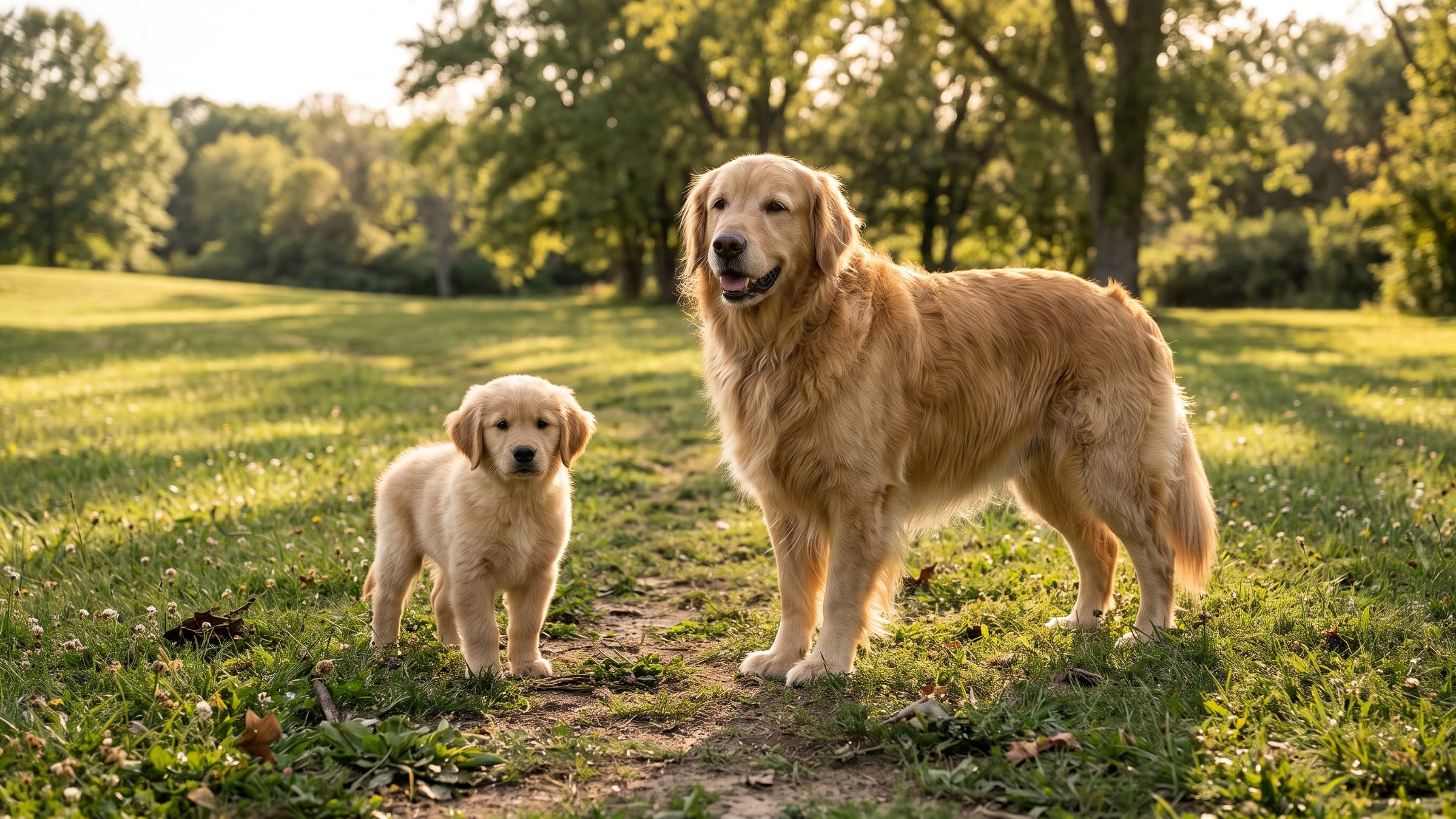
Quick answer: you can estimate your puppy's adult weight by checking what share of adult weight puppies of its size normally reach at its age, then dividing. At 6 months a small breed is about three-quarters grown, a medium breed about two-thirds and a large breed about half to 60% (sources differ slightly). The multiplier chart below does the division for you, and the puppy weight calculator does it from breed and age.
You brought home an eight-week-old ball of fur with paws that look three sizes too big, and now you're trying to figure out if that's a hint or a coincidence. It's a fair question — how big your dog ends up affects everything from the size of crate you buy now to whether your apartment lease has a weight limit you're about to blow past.
There's no single formula that nails it every time, especially for mixed breeds. But there are a few methods that get remarkably close, and knowing how they work is more useful than just plugging in a number and hoping.
Growth rate depends heavily on projected adult size. Small breeds mature fast and finish growing early; giant breeds take almost two years to fill out. The table below is a general reference drawn from common growth-curve patterns vets and breeders use — actual puppies vary by 10-15% in either direction depending on genetics, nutrition, and spay/neuter timing.
| Age | Small Breed (under 25 lbs adult) | Medium Breed (25-50 lbs) | Large Breed (50-90 lbs) | Giant Breed (90+ lbs) |
|---|---|---|---|---|
| 8 weeks | ~20% of adult weight | ~15% | ~10% | ~8% |
| 3 months | ~35% | ~30% | ~20% | ~15% |
| 4 months | ~55% | ~45% | ~30% | ~25% |
| 6 months | ~75% | ~65% | ~50% | ~40% |
| 9 months | ~95% | ~85% | ~70% | ~60% |
| 12 months | 100% | ~95% | ~85% | ~75% |
| 18 months | 100% | 100% | ~98% | ~90% |
| 24 months | 100% | 100% | 100% | 100% |
The short version: if your puppy is a small breed, most of the growing happens in the first six months. If you've got a mastiff or great dane on your hands, they're still filling out well into their second year. If you're not yet sure which of these size tiers your puppy is even headed toward, the Dog Size Calculator lays out the full toy-to-giant scale with expected adult weight ranges so you can see where a projected weight actually lands.
The growth table above gives the share of adult weight reached at each age. Turning it around gives a multiplier: current weight × the number below = estimated adult weight.
| Puppy's age | Small breed | Medium breed | Large breed | Giant breed |
|---|---|---|---|---|
| 8 weeks | ×5.0 | ×6.7 | ×10.0 | ×12.5 |
| 3 months | ×2.9 | ×3.3 | ×5.0 | ×6.7 |
| 4 months | ×1.8 | ×2.2 | ×3.3 | ×4.0 |
| 6 months | ×1.3 | ×1.5 | ×2.0 | ×2.5 |
| 9 months | ×1.1 | ×1.2 | ×1.4 | ×1.7 |
| 12 months | ×1.0 | ×1.1 | ×1.2 | ×1.3 |
Worked example: a 4-month-old medium-breed puppy weighs 20 lb. Medium breeds are about 45% grown at 4 months, so 20 × 2.2 gives an estimate of about 44 lb. A 6-month-old large-breed puppy at 45 lb gives 45 × 2.0, about 90 lb.
Sources differ by up to about 10 percentage points. The AKC puts large breeds at about 60% of adult weight at 6 months, which gives a multiplier closer to 1.7. Use both and treat the answer as a range: in the 6-month example that is about 75–90 lb. A mixed-breed puppy has an even wider range; see our mixed-breed puppy weight chart and the puppy weight chart by breed size.
Paw size. This is the classic backyard method, and it holds up better than people expect for purebred and known-mix puppies. Oversized paws relative to the current body usually signal more growing ahead, since paws often reach close to adult size before the rest of the body catches up.
The doubling rule. For medium and large breeds, a rough estimate is to take the puppy's weight at 4 months and roughly double it. It's not precise, but it's a fast gut check that's held up reasonably well across generations of breeders.
Parent weight averaging. If you know both parents' adult weights, averaging them gets you in the right neighborhood for a purebred litter. For mixed breeds where only one parent is known — common with rescue puppies — this method gets shakier fast.
Breed standard + growth curve. For purebred puppies, breed standards give a target adult weight range, and matching your puppy's current weight against the growth-by-age percentages above narrows it down more precisely than a flat guess.
DNA testing. For mixed breeds where you genuinely have no idea what's in the mix, a DNA test combined with breed-average adult weights is the most reliable option — everything else is estimation layered on estimation.
A purebred litter has a known adult weight range to work from. A mixed breed puppy might carry genes from three or four different breeds with wildly different adult sizes, and which genes dominate isn't visible at 8 weeks. Two puppies from the same litter can end up 20 pounds apart as adults. Any calculator working from a mixed breed's current weight and estimated genetics is giving you a reasonable range, not a guarantee — treat the number as a planning tool, not a fact. If you want a firmer sense of which breeds are actually in the mix rather than working from weight alone, the Dog Breed Percentage / Ancestry Estimator turns a DNA result, or a trait-based guess, into expected size tendencies.
The Mixed-Breed Puppy Weight Calculator is built specifically for this scenario, weighing current weight, age, and paw size together instead of a single breed standard that doesn't exist for your dog. Once you have a projected adult size, the Mixed-Breed Life Expectancy Calculator uses that same size-based logic to estimate lifespan when there's no single breed standard to reference for that either.
Growth charts are a guide, not a report card. A puppy tracking noticeably below the low end of the range for their breed size, especially with a dull coat or low energy, is worth a vet visit to rule out parasites or a nutrition gap. On the other end, a puppy gaining weight much faster than the curve — especially a large or giant breed — should have that flagged too, since rapid early growth in big-breed puppies is linked to a higher risk of joint problems later on. Neither extreme is something to manage off a chart alone; it's a conversation with your vet.
Tracking your puppy's weight against expected growth curves over time, rather than checking once, is exactly what the Dog Growth Calculator is built for.
The parents' adult weights are one of the best guides. Most puppies end up between the two, and females are often a little smaller. If you only know the mother's weight, treat it as a rough guide.
As a rough guide for medium and large breeds, adult weight is often about 2 × the 4-month weight. For small breeds, the 3-month weight × 2 is a rough estimate. Use the puppy weight calculator for a size-specific estimate.
No method predicts adult weight with total precision, and anyone promising an exact number off one data point is overselling it. What you can get is a solid range — enough to size a crate sensibly, budget for food, and know roughly what you're working with before your "ball of fur" turns into 80 pounds of dog.
General guidance on this topic from veterinary organizations. This guide is educational and written by a non-veterinarian; check with your own vet before changing your pet's food, medication or care. Editorial policy
They're a reasonable estimate, not a guarantee — typically within 10-15% for purebred puppies with known parent weights, and wider for mixed breeds. Treat the result as a planning range rather than an exact adult weight.
Around 4-6 months, once growth patterns are more established and paw-to-body proportions start to normalize. Predictions made at 8 weeks are the least reliable, since that's when litter size variation is highest.
Usually, but not always. Paws tend to reach close to adult size before the rest of the body does, so oversized paws are a reasonable signal of more growth ahead — but it's not a precise measurement on its own.
Most small breeds (under 25 lbs adult weight) reach close to their full size by 9-12 months, with the bulk of growth happening in the first six months.
Large breeds typically keep growing until 12-18 months, and giant breeds can continue filling out until 18-24 months. Their growth curve is slower and more gradual than small breeds.
You can estimate a range using current weight, age, and known parent breeds if available, but mixed breed predictions are inherently less precise than purebred ones. A DNA test can narrow things down if you genuinely don't know the breed mix.
For large and giant breeds especially, growing too fast isn't necessarily a good sign — rapid early weight gain has been linked to a higher risk of joint and skeletal problems later on. It's worth mentioning to your vet rather than just feeding to maximize growth.
It can have a modest effect — dogs fixed earlier sometimes end up slightly taller due to delayed growth plate closure — but the impact on overall adult weight is generally small compared to genetics and nutrition.
Combine three clues: the size band of the breed or the parents' adult weights, your puppy's current weight compared with the percent-of-adult-weight chart for its age, and its growth trend over several weigh-ins. Multiplying the current weight by the age multiplier on this page gives a range.
At 4 months a small breed is about 55% of adult weight, a medium breed about 45%, a large breed about 30% and a giant about 25%. Multiply your puppy's weight by about 1.8, 2.2, 3.3 or 4 respectively for a rough estimate.
Yes. Our puppy weight calculator estimates adult weight from your puppy's age, current weight and breed size, and the mixed-breed version handles puppies of unknown parentage.
Paws are a weak clue. Oversized paws on a young puppy often point to more growth, but they mostly reflect that puppies' paws mature before their bodies. Use weight and parent size first.
Most puppies end up between the parents' adult weights, with females often slightly smaller.
Prepare a separate room, swap scent, introduce through a barrier and learn when to slow down if either cat shows tension.
2 min readCreate an indoor setup your cat can explore, with safe hiding spots, scratching surfaces, supervised play and options for smaller homes.
3 min readTry a calm, dog-led walk with safe sniffing stops. Choose a route, use a comfortable pace and adapt the outing for your dog.
3 min read
