 PetCalcStudio

How to Feed Dogs and Cats Separately in a Shared Home
Set up separate feeding stations, measure each pet’s meals and monitor what they actually eat with a simple household routine.
3 min readCare guide
Feed a growing puppy roughly 3 × its resting energy requirement (RER = 70 × body weight in kg^0.75) until about 4 months, then about 2 × RER until it nears adult size, split into 3–4 meals a day, and convert to cups using your food's kcal per cup.
Educational information. Our editorial policy
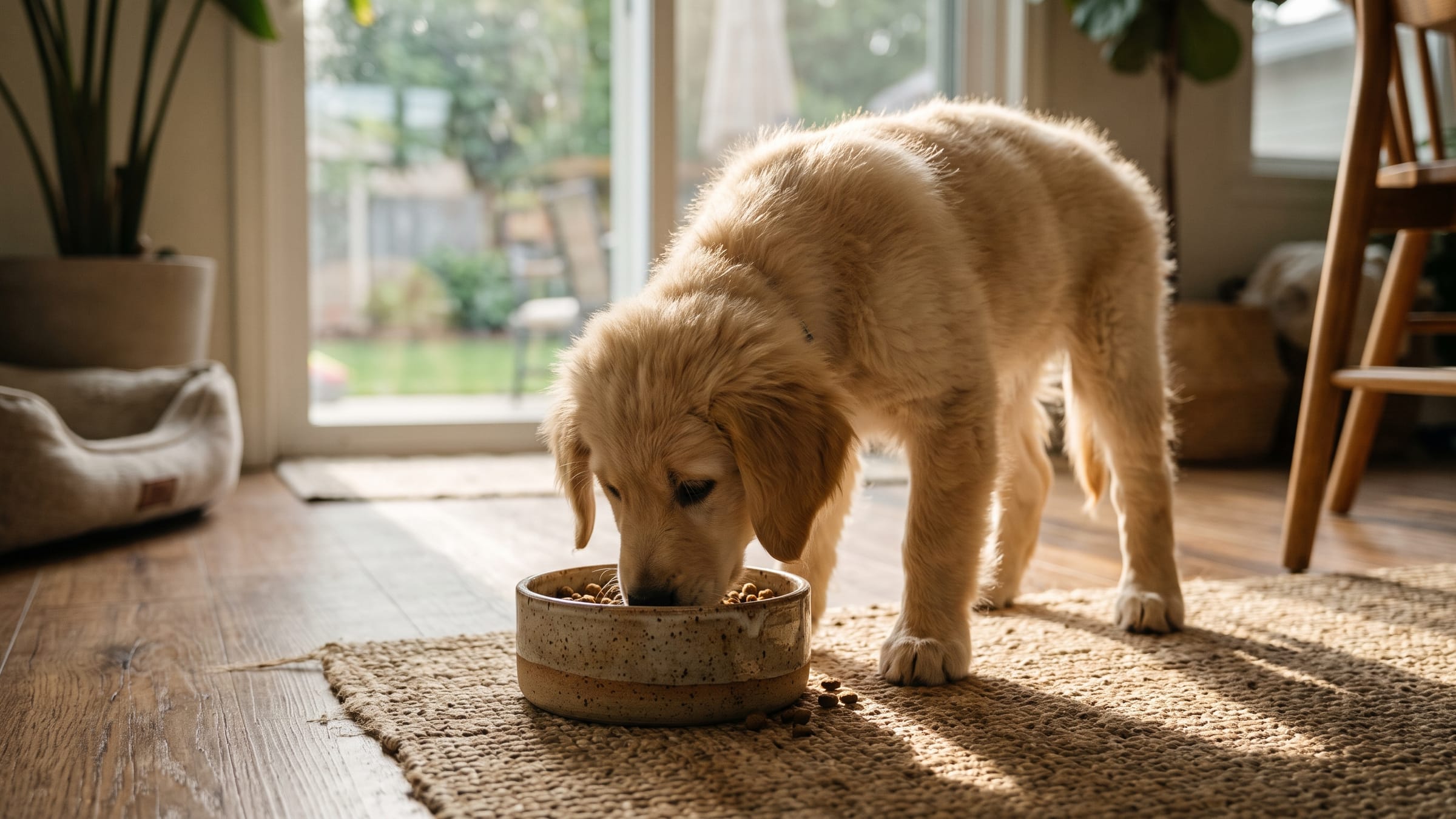
Feed a growing puppy roughly 3 × its resting energy requirement (RER = 70 × body weight in kg^0.75) until about 4 months, then about 2 × RER until it nears adult size, split into 3–4 meals a day, and convert to cups using your food's kcal per cup.
That formula is the backbone of how much to feed a puppy by weight in kg (or lb). It sounds fancy, but it's really just a way to turn a scale reading into a daily calorie target. Skip the math if you like: our dog feeding chart by weight and age does it for you.
Start with the feeding guide on your puppy food's bag. Then check it against the calorie math below, because bag charts are averages and puppies are not.
Three things to remember:
Here are daily calorie targets. Use the "under 4 months" column for young puppies and the "4 months to near adult" column after that.
| Puppy weight | RER (kcal/day) | Under 4 months (×3) | 4 months to near adult (×2) |
|---|---|---|---|
| 2 kg / 4.4 lb | 118 | 353 | 235 |
| 5 kg / 11 lb | 234 | 702 | 468 |
| 10 kg / 22 lb | 394 | 1,181 | 787 |
| 15 kg / 33 lb | 534 | 1,601 | 1,067 |
| 20 kg / 44 lb | 662 | 1,986 | 1,324 |
Treat these as starting points. Active puppies may need more, calm ones less, and large and giant breeds are often kept a bit leaner on purpose because growing too fast can stress their joints. Your vet can tell you where your puppy should land.
This version starts from pounds and shows cups per day for a food with 380 kcal per cup (check your bag, because kcal per cup varies a lot).
| Puppy weight | RER (kcal/day) | Under 4 months (×3) | 4 months to near adult (×2) |
|---|---|---|---|
| 3 lb (1.4 kg) | 88 | 265 (0.7 cups) | 176 (0.5 cups) |
| 8 lb (3.6 kg) | 184 | 552 (1.5 cups) | 368 (1.0 cups) |
| 15 lb (6.8 kg) | 295 | 885 (2.3 cups) | 590 (1.6 cups) |
| 25 lb (11.3 kg) | 433 | 1,298 (3.4 cups) | 865 (2.3 cups) |
| 35 lb (15.9 kg) | 557 | 1,670 (4.4 cups) | 1,113 (2.9 cups) |
| 50 lb (22.7 kg) | 727 | 2,182 (5.7 cups) | 1,455 (3.8 cups) |
Cups are a rounded guide. Weigh your puppy every week or two, recalculate as it grows and ask your vet before changing to adult food. If your puppy is a large or giant breed, keep growth steady rather than fast.
Let's do one by hand. Meet Milo, a 3-month-old puppy who weighs 10 kg (22 lb).
At 5 months, if Milo weighs 15 kg (33 lb), the math becomes: 15^0.75 is about 7.62, RER = 70 × 7.62 = 534 kcal, and × 2 = about 1,067 kcal/day.
Weigh your puppy, plug the number into the dog food calculator by weight and age, and recheck every couple of weeks as the scale climbs.
Calories are only useful once you know what's in the bowl. Look on the bag for kcal per cup (or kcal per kg).
Milo's food says 380 kcal per cup, which equals about 3,800 kcal per kg.
Split that across the day's meals. At 4 months and older, Milo's 787 kcal target would be about 2.1 cups (about 207 g).
Two tips: use a proper measuring cup or, better, a kitchen scale, because scoops vary a lot. And count treats. If treats and chews add up to more than about 10% of the day's calories, trim the meals to match.
You can also find a broader look at growth in our puppy weight calculator and the dog food calculator.
| Age | Meals per day |
|---|---|
| 6–12 weeks | 4 |
| 3–6 months | 3 |
| 6–12 months | 2 |
Toy and small breeds are prone to low blood sugar, so many vets keep them on 3–4 small meals for longer. Feeding at regular times helps with house training, too.
Also look at your puppy's expected weight at each stage so you know what to expect on the scale, and see how weekly gain should look.
The scale tells you weight. Your hands tell you condition. Run them over your puppy's ribs:
A slightly lean puppy is healthier than a chunky one, especially in bigger breeds. If your puppy is always ravenous but looks thin, see the vet before adding food. Worms are a common culprit. Our guide on how to help a puppy gain weight safely covers that in more detail.
The calorie math gives you a starting line, not a finish line. A few things move it:
Call your vet if you notice:
At 8 weeks, split the day's food into 4 meals. Work out calories as about 3 × RER for your puppy's current weight, then use the kcal on your food's label.
At about 3–4 weeks, puppies start on a soft gruel of puppy food mixed with milk replacer, while still nursing. They are usually fully weaned at about 7–8 weeks.
Don't starve a young puppy. Call your vet the same day for diarrhoea in a puppy, especially with vomiting, blood or lethargy; they can dehydrate quickly.
General guidance on this topic from veterinary organizations. This guide is educational and written by a non-veterinarian; check with your own vet before changing your pet's food, medication or care. Editorial policy
It depends on age. A 10 kg (22 lb) puppy under 4 months needs roughly 1,180 kcal a day (RER × 3), which is about 3 cups of a 380 kcal-per-cup food. After 4 months, the target drops to roughly 790 kcal (about 2 cups of that same food). Always confirm using your own food's kcal per cup.
Use current weight. Puppies' needs follow what they weigh today, and you adjust as they grow. Expected adult size matters for choosing the type of food (for example, a large-breed puppy formula), not for portion size.
Most puppies move from 3 meals to 2 somewhere around 6 months. Toy breeds and puppies with blood sugar issues may need to stay on 3 meals longer. Move gradually, and ask your vet if your puppy seems hungry between meals.
Every 1–2 weeks while your puppy is growing fast. If your puppy is gaining faster than the growth curve for its size, trim slightly. If it looks thin, talk to your vet.
Work out resting energy (RER = 70 × kg^0.75) and multiply by 3 until about 4 months, then by 2 until near adult size. For example, a 15 lb (6.8 kg) puppy under 4 months needs about 880 kcal a day. Convert to cups using your food's kcal per cup.
Divide the daily calorie target by your food's kcal per cup. With a 380 kcal per cup food, a 15 lb (6.8 kg) puppy over 4 months needs about 590 ÷ 380, or roughly 1.6 cups per day, split across meals. Always check against the feeding guide on your food's bag and your puppy's body condition.
It is a starting point. Puppies of the same weight can need different amounts depending on breed, activity and neutering, so adjust to body condition and recheck every two weeks.
About 4 meals a day, dropping to 3 meals around 3–4 months.
Set up separate feeding stations, measure each pet’s meals and monitor what they actually eat with a simple household routine.
3 min readSet up safe storage for dry pet food and opened wet food. Keep lot codes handy and learn what to do with leftovers and damaged packaging.
3 min readConvert cups to grams using your food’s own label. See worked examples, avoid scoop errors, and measure an existing feeding plan more consistently.
3 min read
