 PetCalcStudio

How to Feed Dogs and Cats Separately in a Shared Home
Set up separate feeding stations, measure each pet’s meals and monitor what they actually eat with a simple household routine.
3 min readCare guide
Understand kcal/kg, kcal/cup and kcal/can, then convert a planned calorie amount into grams. Includes US and European label guidance and worked examples.
Educational information. Updated . Our editorial policy
AI-generated editorial image · View full-size image ↗
The useful answer
Use the calorie statement for your exact recipe, then convert an already established calorie allowance into a measurable amount. Protein percentages and cup sizes cannot substitute for energy density.
Put the guide into practice
Use your exact food label and an amount from an existing plan. This converter does not decide how much your pet should eat.
Enter positive values in every field to see the calculation.
Numbers entered here stay in this page and are not sent to our server.
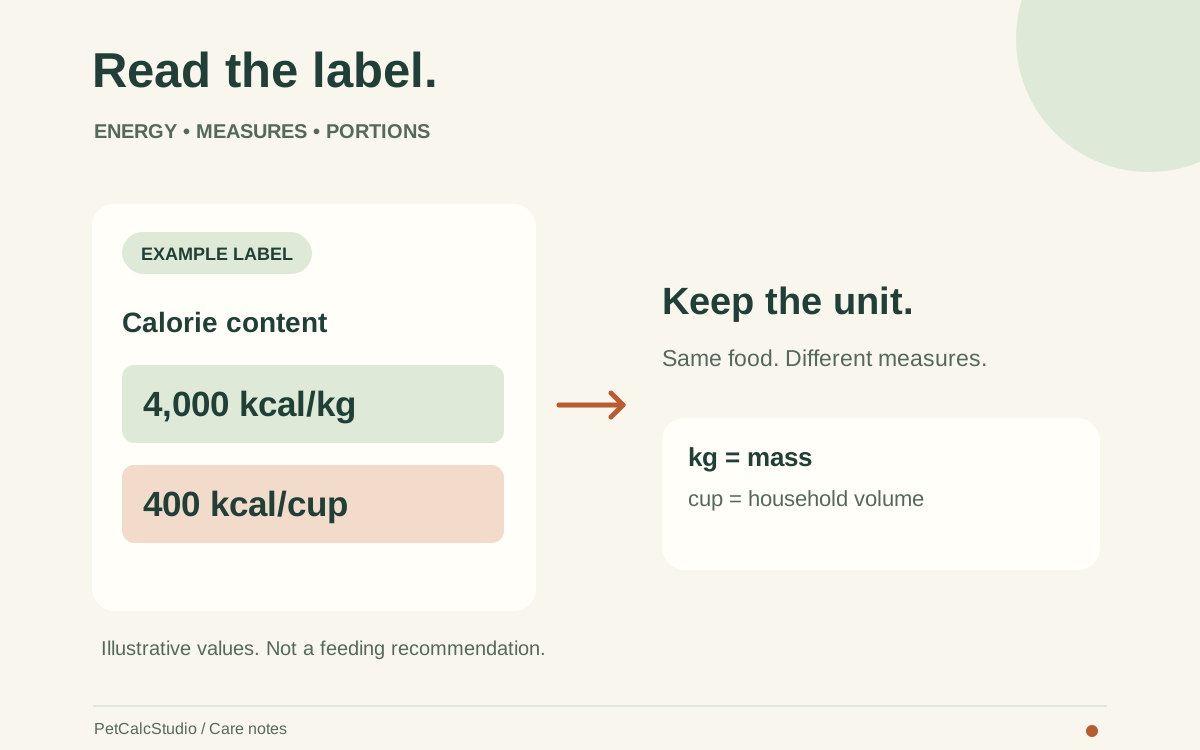
Find the energy value and its unit before entering a number into a feeding calculator. “4,000 kcal/kg” and “400 kcal/cup” can describe the same food. They use different amounts of food as their reference. In everyday nutrition language, a food Calorie is a kilocalorie, or kcal.
| Label unit | What it describes | Example calculation |
|---|---|---|
| kcal/kg | Energy in 1,000 g of this food | 4,000 kcal/kg = 4 kcal/g |
| kcal/100 g | Energy in 100 g of this food | 95 kcal/100 g = 0.95 kcal/g |
| kcal/cup | Energy in the manufacturer’s specified cup measure | 400 kcal/cup × 0.5 cup = 200 kcal |
| kcal/can or pouch | Energy in that exact package size | 85 kcal/pouch × 2 pouches = 170 kcal |
These are hypothetical labels, not typical values for a particular brand. A different can size or recipe requires its own value. Do not use calories per serving as calories per whole package unless the serving is the whole package.
Grams = planned kcal ÷ kcal per gram. If a hypothetical plan assigns 600 kcal to a food with 4,000 kcal/kg, the arithmetic is 600 ÷ 4 = 150 g. The converter above starts with an amount you supply; it does not determine an animal’s calorie requirement.
For a food labeled in kcal/100 g, divide the label number by 100 first. A planned 190 kcal from a food with 95 kcal/100 g means 190 ÷ 0.95 = 200 g. This conversion concerns energy only, not whether the diet is suitable for the animal.
WSAVA’s North American label guide explains the calorie-content statement in weight and household units. Its European guide distinguishes complete from complementary food and notes that energy density may not appear on the package. Check the exact product’s technical information or ask the manufacturer when a calorie value is missing.
Use values for the food as sold, unless a professional has specifically instructed otherwise. Do not mix dry-matter nutrient percentages with as-fed energy values. A protein percentage is not a kcal number, and an ingredient list alone does not provide the inputs for a dependable calorie conversion.
Take a clear photograph of these details before recycling the package. Ask the manufacturer to clarify any conflicting values rather than selecting the number that produces the portion you expect.
Continue with the cup-to-gram guide, mixed-feeding example for cats, or dog food calculator. Re-enter label details when changing products. A previous portion expressed in cups or grams does not automatically transfer to a new recipe.
Sources checked 2026-11-20. Written by Heromedia for PetCalcStudio. This is an editorial source check, not an independent veterinary review. Worked examples are illustrative and do not establish an individual pet’s needs.
Checked against the sources below by the editorial team. This is not an independent veterinary review.
Set up separate feeding stations, measure each pet’s meals and monitor what they actually eat with a simple household routine.
3 min readSet up safe storage for dry pet food and opened wet food. Keep lot codes handy and learn what to do with leftovers and damaged packaging.
3 min readConvert cups to grams using your food’s own label. See worked examples, avoid scoop errors, and measure an existing feeding plan more consistently.
3 min read
