 PetCalcStudio

How to Feed Dogs and Cats Separately in a Shared Home
Set up separate feeding stations, measure each pet’s meals and monitor what they actually eat with a simple household routine.
3 min readCare guide
Understand why dog weight alone cannot set a portion. Compare grams at different food calorie densities and convert an established daily calorie plan correctly.
Educational information. Updated . Our editorial policy
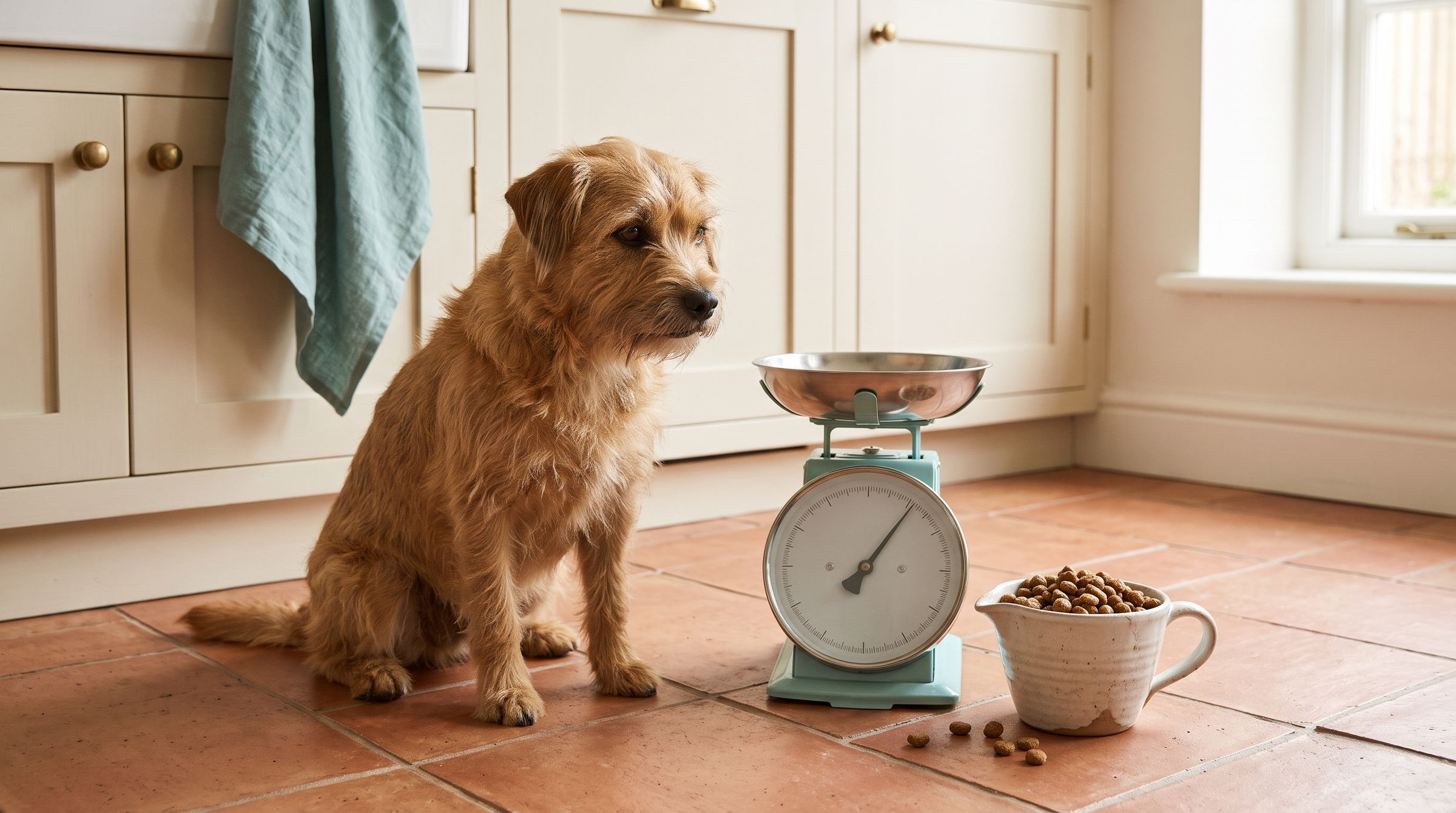
There is no universal grams-per-day chart based only on dog weight. A portion needs both an appropriate energy plan for the dog and the energy density of the exact food. Two foods can require different gram amounts to supply the same calories.
AAHA distinguishes resting energy requirement (RER) from maintenance needs. The familiar formula, RER = 70 × body weight in kg0.75, estimates resting energy; it is not automatically the dog’s daily ration. Life stage and individual assessment affect how it is used.
Use the dog food calculator to explore a starting estimate and its assumptions. For an individual feeding plan, discuss the result with your veterinary team. WSAVA provides nutritional-assessment and body-condition resources to support that discussion.
The table below starts with calories already assigned to one food. It does not assign those amounts to a particular dog weight, breed or age. Values are rounded to the nearest gram.
| Calories assigned to this food | 3,200 kcal/kg | 3,600 kcal/kg | 4,000 kcal/kg |
|---|---|---|---|
| 300 kcal | 94 g | 83 g | 75 g |
| 500 kcal | 156 g | 139 g | 125 g |
| 700 kcal | 219 g | 194 g | 175 g |
| 900 kcal | 281 g | 250 g | 225 g |
For example, 700 kcal ÷ (3,600 ÷ 1,000) = 194.4 g. At 4,000 kcal/kg, the same 700 kcal uses 175 g. The difference comes from the foods, not a change in the dog.
Find kcal/kg on the label or request it from the manufacturer. Divide by 1,000 to get kcal/g, then divide the calories assigned to that food by kcal/g. If several foods contribute to the daily plan, allocate their calories before converting each one.
Use our food-label converter to check the units. For cups, use the product-specific cup-to-gram conversion. Do not borrow a density from a similarly named recipe or assume a household scoop holds a universal weight.
If an established daily amount is 180 g and the plan uses two equal meals, each meal is 90 g. Count any of the same food set aside for toys or training within that daily amount. Write down what each person should serve so everyone follows the same plan.
AAHA recommends tracking body weight and body condition and counting all food sources. A number that looks precise is still an estimate of a biological need. Ask for an individual plan for growth, pregnancy, illness or weight management rather than applying this conversion chart as treatment.
When the plan changes, update the label value, daily amount and meal note together. Then use the food supply calculator to plan purchases from that amount.
Sources checked 2026-11-20. Written by Heromedia for PetCalcStudio. This is an editorial source check, not an independent veterinary review. Worked examples are illustrative and do not establish an individual pet’s needs.
Checked against the sources below by the editorial team. This is not an independent veterinary review.
Set up separate feeding stations, measure each pet’s meals and monitor what they actually eat with a simple household routine.
3 min readSet up safe storage for dry pet food and opened wet food. Keep lot codes handy and learn what to do with leftovers and damaged packaging.
3 min readConvert cups to grams using your food’s own label. See worked examples, avoid scoop errors, and measure an existing feeding plan more consistently.
3 min read
