 PetCalcStudio

How to Introduce Two Cats at Their Own Pace
Prepare a separate room, swap scent, introduce through a barrier and learn when to slow down if either cat shows tension.
2 min readCare guide
Work out how many days a food bag will last and its cost per day using your actual daily portion. Includes kg/lb conversion and a clear worked example.
Educational information. Updated . Our editorial policy
AI-generated editorial image · View full-size image ↗
The useful answer
Divide the food weight by the amount used each day, using matching units. This estimates stock and spending; it does not establish a suitable ration or an opened bag’s shelf life.
Put the guide into practice
Use the daily amount from your existing feeding plan. The price is the amount paid in the selected currency; no currency conversion is performed.
Enter positive values in every field to see the calculation. A price of zero is allowed.
Numbers entered here stay in this page and are not sent to our server.
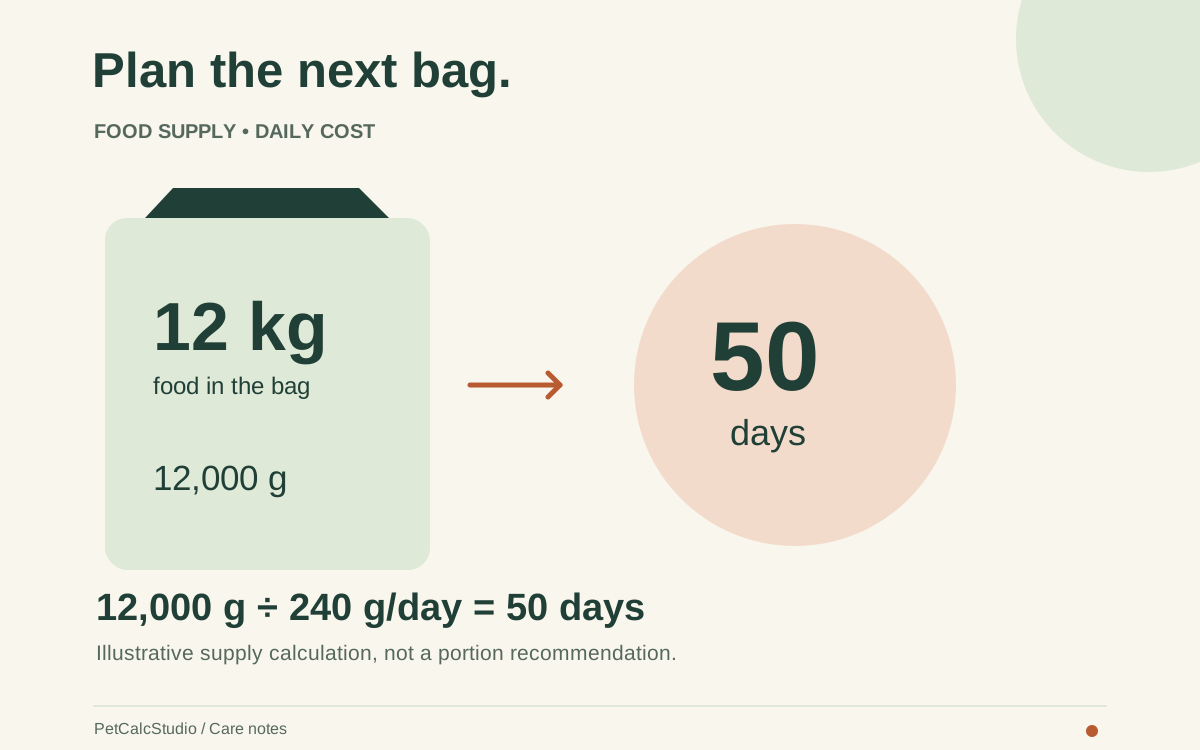
Divide the food in the bag by the amount used each day. A 12 kg bag contains 12,000 g. If a household uses 240 g daily, it provides 50 days of food. This is a stock estimate, not a recommendation to feed 240 g.
The calculator above accepts the daily grams from your existing plan and the price you actually pay. It estimates food use only; it cannot tell whether a ration meets your pet’s needs or whether an opened bag will stay suitable for that long.
If your plan uses cups, first use the food-specific cups-to-grams converter. For a partly used bag, enter the remaining food weight. For pounds, the exact conversion is 1 lb = 453.59237 g.
| Input or result | Example |
|---|---|
| Bag weight | 12 kg = 12,000 g |
| Daily use | 240 g |
| Bag price | 60 currency units |
| Days of supply | 12,000 ÷ 240 = 50 days |
| Food cost per day | 60 ÷ 50 = 1.20 |
| Food used over 30 days | 240 × 30 = 7.2 kg |
| Cost of 30 days of food used | 1.20 × 30 = 36.00 |
The 30-day figure represents food consumed, not necessarily the money leaving your account in that month. Buying a full bag costs 60 in this example, even when some remains for the next month. A 30-day budget is also different from a 31-day calendar month.
Add daily use only for animals eating this same product. If one dog uses 140 g and another uses 180 g, the household uses 320 g of that food per day. Keep separate calculations for different recipes. Food put into training toys counts as food used; spilled or discarded food can make actual supply shorter.
Recalculate whenever the prescribed portion, household or product changes. For a growing puppy, today's daily intake should not be treated as a forecast for several months.
FDA advises keeping the original packaging, including batch and best-before details, and storing food securely in a cool, dry place. An estimate of 80 days of supply does not establish an 80-day opened shelf life. Follow the manufacturer’s opening and storage advice; ask them if it is unclear.
When recipes have different energy densities, the same number of grams may provide different calories. Compare prices using an appropriate daily amount for each recipe, rather than assuming a cheaper bag costs less to feed. Our label guide explains kcal/kg.
Bring this result into your annual dog budget, alongside grooming, routine care and other local quotes. Record when and where you obtained a price so future comparisons have context.
Sources checked 2026-11-20. Written by Heromedia for PetCalcStudio. This is an editorial source check, not an independent veterinary review. Worked examples are illustrative and do not establish an individual pet’s needs.
Checked against the sources below by the editorial team. This is not an independent veterinary review.
Prepare a separate room, swap scent, introduce through a barrier and learn when to slow down if either cat shows tension.
2 min readCreate an indoor setup your cat can explore, with safe hiding spots, scratching surfaces, supervised play and options for smaller homes.
3 min readTry a calm, dog-led walk with safe sniffing stops. Choose a route, use a comfortable pace and adapt the outing for your dog.
3 min read
