 PetCalcStudio

How to Feed Dogs and Cats Separately in a Shared Home
Set up separate feeding stations, measure each pet’s meals and monitor what they actually eat with a simple household routine.
3 min readCare guide
AAFCO sets minimums of 26% protein on a dry-matter basis for adult cat food and 30% for kitten or growth food. Many healthy cats do well above that. To compare wet and dry foods fairly, convert the label's "crude protein" to a dry-matter basis first.
Educational information. Our editorial policy
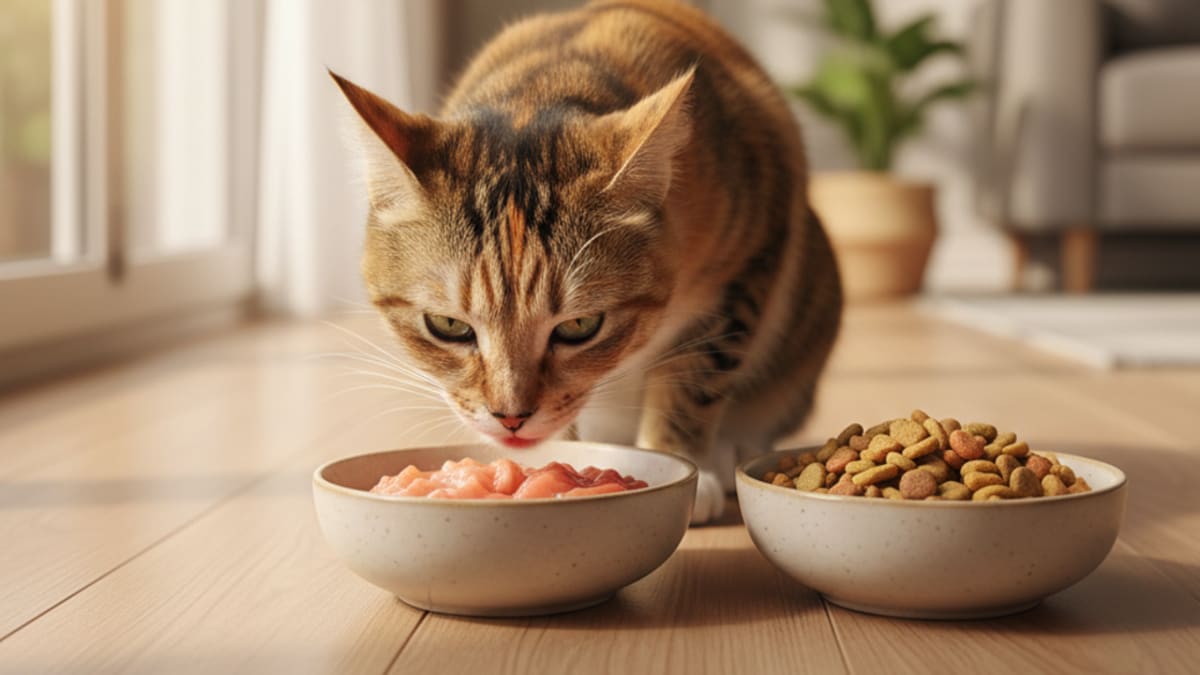
AAFCO sets minimums of 26% protein on a dry-matter basis for adult cat food and 30% for kitten or growth food. Many healthy cats do well above that. To compare wet and dry foods fairly, convert the label's "crude protein" to a dry-matter basis first.
If you've ever wondered how much protein is in cat food, and why a can of wet food shows "10%" while kibble shows "32%," the label is playing a trick on you. The two aren't measured on the same footing. Here's how to level the playing field. For portions once you've picked a food, use our how much food should I feed my cat calculator.
The Association of American Feed Control Officials (AAFCO) sets nutrient profiles for "complete and balanced" pet foods. For cats, the minimum crude protein is:
| Life stage | Minimum protein (dry-matter basis) |
|---|---|
| Adult maintenance | 26% |
| Growth and reproduction (kittens, pregnant or nursing cats) | 30% |
These are minimums, not targets. Cats are obligate carnivores and generally do well on diets that go beyond the floor. Lots of cat foods land in the 35–50% range on a dry-matter basis.
Look for the statement on the package that the food is "complete and balanced" for a life stage. That tells you the food was formulated or tested to meet AAFCO profiles.
The "crude protein" on a label is measured as fed, which means including the water in the food.
Water has no protein. So a can with 78% water can only have so much protein in the remaining 22%. It might look low next to kibble, but it may be higher once you remove the water from the math. That's what "dry-matter basis" means: the nutrient level if the food had zero moisture.
Also note that "crude protein" only measures nitrogen, not how digestible or well-balanced the protein is. Two foods with the same number can differ in quality. It's a starting point, not a verdict.
The formula:
Protein (dry matter) = crude protein % ÷ (100 − moisture %) × 100
You'll need two numbers from the "guaranteed analysis" panel: crude protein (usually "min") and moisture ("max").
Example 1: canned food. Crude protein 10%, moisture 78%.
Example 2: dry food. Crude protein 32%, moisture 10%.
So the can that looked "low" (10%) actually has more protein per bite of food solids than the kibble that looked "high" (32%).
Example 3: a pâté. Crude protein 8%, moisture 82%. Dry matter is 18%, and 8 ÷ 18 = about 44%.
| Food | Crude protein (as fed) | Moisture | Protein (dry matter) |
|---|---|---|---|
| Canned A | 10% | 78% | 45.5% |
| Pâté B | 8% | 82% | 44.4% |
| Kibble C | 32% | 10% | 35.6% |
The label numbers are guaranteed minimums and maximums, so your real result is approximate. It's still a fair way to compare.
Want a shortcut? Our dry matter basis calculator does the same math (it's on the dog protein page, but the conversion works the same for cat food). For portions, see the cat calorie calculator. And if you're mixing foods, see how to split calories in our wet and dry feeding guide.
For portion sizes by age, see how much a kitten or 1-year-old cat should eat, and for what changes with age, see what age a cat is a senior.
For most healthy cats, high protein isn't a problem. The exception is cats with kidney disease or certain other conditions. Vets sometimes recommend controlled protein and phosphorus for those cats. That's a medical decision, not something to do on your own, because cutting protein in a cat that doesn't need it can cause muscle loss.
So: if your cat has been diagnosed with kidney disease, follow your vet's diet plan. If your cat is healthy, more protein than the minimum is generally fine.
Don't judge a food by protein alone. Look at calories, ingredients, moisture and whether the food fits your budget and your cat's tastes. For the cost side, see our cat food cost calculator and our look at how much Smalls cat food costs.
Protein is only one piece. When you compare foods, also look at:
The best food is one your cat enjoys, digests well and keeps a healthy weight on.
Talk to your vet before changing your cat's protein level, and call sooner if you see:
General guidance on this topic from veterinary organizations. This guide is educational and written by a non-veterinarian; check with your own vet before changing your pet's food, medication or care. Editorial policy
It meets AAFCO's minimum for both adult and kitten foods, if that's a dry-matter figure. If 30% is the as-fed number on a dry food with about 10% moisture, it's about 33% on a dry-matter basis. That's fine for a healthy adult, though many foods go higher.
Because wet food is mostly water, and the label reports protein as fed. Convert to dry matter and it often comes out at 40–50%, higher than kibble.
Not automatically. Healthy senior cats generally still need good protein to keep muscle. Cats with kidney disease may need a different plan, and your vet should decide that.
Look at the guaranteed analysis panel. It lists "moisture (max)" alongside crude protein, fat and fiber. If it's missing, check the manufacturer's website.
Set up separate feeding stations, measure each pet’s meals and monitor what they actually eat with a simple household routine.
3 min readSet up safe storage for dry pet food and opened wet food. Keep lot codes handy and learn what to do with leftovers and damaged packaging.
3 min readConvert cups to grams using your food’s own label. See worked examples, avoid scoop errors, and measure an existing feeding plan more consistently.
3 min read
