 PetCalcStudio

How to Feed Dogs and Cats Separately in a Shared Home
Set up separate feeding stations, measure each pet’s meals and monitor what they actually eat with a simple household routine.
3 min readCare guide
Calculate cans or pouches from an established calorie allowance and the exact package label. Compare serving sizes without assuming every can has the same calories.
Educational information. Updated . Our editorial policy
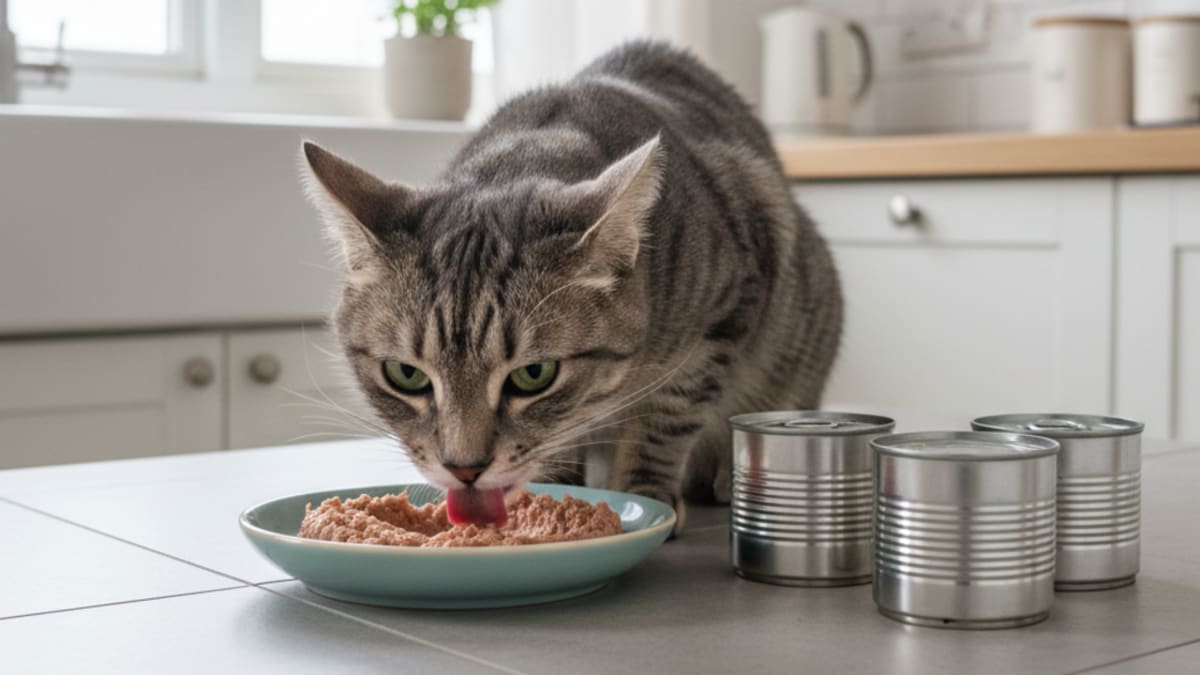
Divide the calories assigned to wet food by the calories in one can or pouch. Can size alone is not enough: recipes with the same package weight may contain different amounts of energy. Check the exact food and package you are feeding.
Use an existing feeding plan or ask your veterinary team to help establish one. Cats Protection recommends adjusting portions to the individual and seeking advice about weight or appetite concerns. A standard can count is not a substitute for that assessment.
If dry food, treats or another food also contribute calories, account for them before assigning the wet-food portion. Our mixed-feeding guide shows how to keep both foods within one plan.
Imagine an established plan allocates 180 kcal per day to wet food. The following table uses hypothetical label values and makes no recommendation that a particular cat should receive 180 kcal.
| Energy in one package | Calculation | Daily quantity |
|---|---|---|
| 60 kcal/pouch | 180 ÷ 60 | 3 pouches |
| 90 kcal/can | 180 ÷ 90 | 2 cans |
| 120 kcal/can | 180 ÷ 120 | 1.5 cans |
| 180 kcal/can | 180 ÷ 180 | 1 can |
A “half can” is meaningful only when everyone knows which can. Record the brand, recipe and package size beside the portion. Recalculate after a recipe or package change rather than continuing the old can count.
Divide the energy value by 100 to find kcal/g. With a hypothetical 90 kcal/100 g food, a 180 kcal allocation uses 200 g. If each can contains 100 g, that is two cans. If each can contains 200 g, it is one can. The total food weight is unchanged.
The calorie-label guide includes a converter and explains the difference between kcal/kg, kcal/cup and kcal/can. Ask the manufacturer for missing energy information rather than inferring it from the ingredient list.
Write down the daily quantity first, then record the amount offered at each planned meal. A note saying “two cans daily” is different from “two cans per meal.” Track leftovers when you need to know actual intake: food placed in the bowl is not always food eaten.
In a multi-cat household, try to keep the records specific to each cat. A household total divided by the number of cats does not establish that each individual consumed an equal amount.
FDA advises promptly refrigerating or discarding unused wet food and cleaning bowls and measuring utensils after use. Follow the manufacturer’s storage directions after opening. Portion arithmetic does not determine how long food can be kept or left in a bowl.
This is an energy-to-quantity conversion, not a kitten, weight-loss or medical feeding protocol. Discuss changes in appetite or weight with your veterinarian. The cat feeding planner can help organize the arithmetic once the assumptions are appropriate.
Sources checked 2026-11-20. Written by Heromedia for PetCalcStudio. This is an editorial source check, not an independent veterinary review. Worked examples are illustrative and do not establish an individual pet’s needs.
Checked against the sources below by the editorial team. This is not an independent veterinary review.
Set up separate feeding stations, measure each pet’s meals and monitor what they actually eat with a simple household routine.
3 min readSet up safe storage for dry pet food and opened wet food. Keep lot codes handy and learn what to do with leftovers and damaged packaging.
3 min readConvert cups to grams using your food’s own label. See worked examples, avoid scoop errors, and measure an existing feeding plan more consistently.
3 min read
