 PetCalcStudio

How to Introduce Two Cats at Their Own Pace
Prepare a separate room, swap scent, introduce through a barrier and learn when to slow down if either cat shows tension.
2 min readCare guide
How much should you walk your dog? It depends entirely on breed, age, and health — not a generic timer. This guide covers daily distance targets by breed group, the puppy 5-minute rule, senior walking modifications, and how to calculate the right distance for your specific dog.
Educational information. Our editorial policy
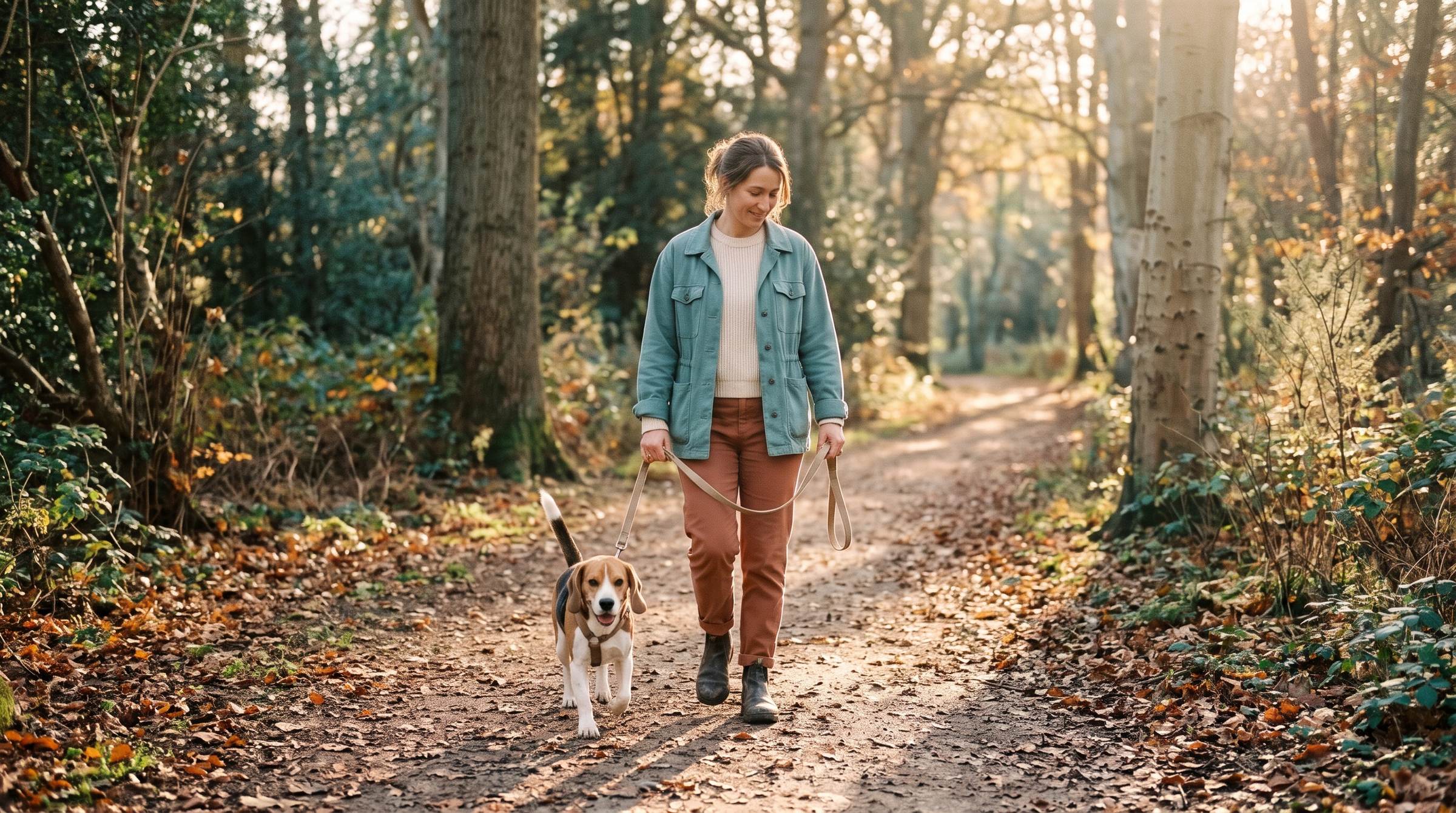
Quick answer: most healthy adult dogs need 30 to 90 minutes of walking a day, which is about 1 to 5 miles. Low-energy and flat-faced breeds sit near 20–30 minutes, medium breeds near 45–60, and high-energy working breeds need 90 minutes or more plus off-leash running. Puppies follow the 5-minute rule (5 minutes per month of age, twice a day) and seniors need 30–50% less than their adult peak.
Distance depends on pace as much as time. At a relaxed, sniff-and-stroll pace most dogs cover about 2 miles an hour; on a brisk leash walk it is closer to 3.
| Walk length | Easy pace (2 mph) | Brisk pace (3 mph) |
|---|---|---|
| 15 min | 0.5 mi (0.8 km) | 0.8 mi (1.2 km) |
| 20 min | 0.7 mi (1.1 km) | 1.0 mi (1.6 km) |
| 30 min | 1.0 mi (1.6 km) | 1.5 mi (2.4 km) |
| 45 min | 1.5 mi (2.4 km) | 2.2 mi (3.6 km) |
| 60 min | 2.0 mi (3.2 km) | 3.0 mi (4.8 km) |
| 90 min | 3.0 mi (4.8 km) | 4.5 mi (7.2 km) |
| 120 min | 4.0 mi (6.4 km) | 6.0 mi (9.7 km) |
Use this to turn the minutes in the breed sections below into miles. Off-leash dogs that run out and back often cover noticeably more ground than the person holding the lead.
The commonly repeated advice of "30 minutes twice a day" is a reasonable baseline for a medium-sized adult dog of average energy. For a Siberian Husky, it's a warm-up. For a Cavalier King Charles Spaniel, it's probably adequate. For a senior Dachshund with disc disease, it may be too much.
Exercise recommendations need to account for breed group and working heritage, age, size, health status, and temperature and environment — particularly for brachycephalic breeds at heat risk.
Breeds: Border Collie, Australian Shepherd, Siberian Husky, Malamute, Weimaraner, Vizsla, Belgian Malinois, Jack Russell Terrier, Dalmatian, Rhodesian Ridgeback, German Shorthaired Pointer, Irish Setter
Daily target: 90 minutes minimum, ideally 2+ hours. 5–10 miles of walking plus off-leash running or structured play. Walking alone is often insufficient — these breeds need cardiovascular output beyond leash walking.
Breeds: Labrador Retriever, Golden Retriever, German Shepherd, Standard Poodle, Boxer, Doberman, Rottweiler, English Springer Spaniel, Cocker Spaniel, Brittany, Whippet, Greyhound
Daily target: 60–90 minutes, 3–5 miles. Despite their speed, Greyhounds are sprinters not endurance athletes — many are satisfied with two 20–30 minute walks and a short sprint session.
Breeds: Beagle, Border Terrier, Corgi (Pembroke and Cardigan), Shetland Sheepdog, Standard Schnauzer, Bull Terrier, Samoyed, Chow Chow, Basenji, Airedale Terrier
Daily target: 45–60 minutes, 2–3 miles.
Breeds: Cavalier King Charles Spaniel, Shih Tzu, Maltese, Bichon Frise, Pomeranian, Miniature Schnauzer, Miniature Poodle, Dachshund, Havanese, Lhasa Apso
Daily target: 30–45 minutes, 1–2 miles.
Breeds: English Bulldog, French Bulldog, Pug, Boston Terrier, Pekinese
Daily target: 20–30 minutes in cool conditions, broken into 2–3 shorter sessions. Never walk brachycephalic breeds in temperatures above 75°F (24°C) without close monitoring. Stop immediately at any sign of heavy panting or distress. Before heading out on a warm day, the Dog Sunburn / Heat Index Safety Calculator checks current temperature, humidity, and pavement heat against your dog's risk factors to tell you whether it's actually safe to walk right now, rather than guessing from how hot it feels to you.
Breeds: Great Dane, Saint Bernard, Irish Wolfhound, Newfoundland, Mastiff
Adult daily target: 45–60 minutes, 2–3 miles. Critical rule: Do not force high-impact exercise on giant breed puppies until 18–24 months — their growth plates close later than smaller breeds.
5 minutes of structured walking per month of age, twice daily.
| Puppy Age | Max Walk Duration (per session) | Max Daily Total |
|---|---|---|
| 8 weeks (2 months) | 10 minutes | 20 minutes |
| 3 months | 15 minutes | 30 minutes |
| 4 months | 20 minutes | 40 minutes |
| 5 months | 25 minutes | 50 minutes |
| 6 months | 30 minutes | 60 minutes |
| 9 months | 45 minutes | 90 minutes |
| 12 months | 60 minutes | Breed-appropriate adult levels |
This rule exists to protect developing growth plates. Overwalking a puppy causes structural damage that shortens the dog's athletic life and increases arthritis risk significantly. Puppies self-regulate during free play — leash walking forces them to maintain pace regardless of how they feel.
Puppies in high growth periods need significantly more calories. See our Dog Food Calculator for puppy-specific portion guidance.
Adult dogs should receive the full breed-appropriate daily exercise amount. Under-exercise during the adult years does the most cumulative damage — behavioural problems and obesity developed now are harder to reverse in old age.
Continued exercise is essential for seniors — complete cessation causes muscle atrophy and accelerates joint deterioration. But sessions should shift: shorter, softer surfaces, lower impact, closer monitoring.
Use our Pet Age Calculator to identify your dog's biological life stage before adjusting their exercise regime.
| Senior Dog Size | Recommended Daily Distance |
|---|---|
| Small senior (<20 lbs) | 1–2 miles, 2–3 sessions |
| Medium senior (20–50 lbs) | 1.5–3 miles, 2–3 sessions |
| Large senior (50–90 lbs) | 1–2.5 miles, 2–3 sessions |
| Giant senior (90+ lbs) | 0.75–1.5 miles, 2–3 sessions |
A healthy, conditioned dog can walk a long way, and fit working and sporting breeds can manage 10 miles or more on a hiking day. That is a ceiling for a trained dog, not a daily target. Distance should be built up over weeks, with water breaks, shade and a check of paw pads afterwards. Daily needs by breed group are in the sections above: roughly 1–2 miles for low-medium energy dogs, 2–3 for medium, 3–5 for medium-high and 5–10+ for the highest-drive breeds.
Usually not as a daily routine. Small, low-medium energy breeds such as the Shih Tzu, Maltese and Pomeranian are comfortable at 1–2 miles a day. A fit adult can manage a longer slow route (3 miles or so) once it is conditioned, but 5 miles in one go is a lot for short legs. Shih Tzus are also brachycephalic, so skip long walks in warm weather, carry water, and turn back at the first sign of heavy panting or lagging.
By the 5-minute rule a 4-month-old puppy gets about 20 minutes per session, twice a day. At a slow puppy pace that is roughly half a mile to a mile a day in total. Free play in the garden counts too, so do not stack long leash walks on top of it.
Leave 1–2 hours between a large meal and vigorous exercise. Deep-chested breeds such as Great Danes, Weimaraners and Standard Poodles carry the highest risk of bloat (gastric dilatation-volvulus), which is an emergency. A calm toilet stroll after a small meal is generally fine. After a hard walk, let your dog cool down and stop panting before the bowl comes out, usually 30 minutes to an hour. If your dog is eating less after walks, or you are also changing portions, recalculate with the Dog Food Calculator.
Short and often beats long and rare. Many vets suggest starting with 5–15 minute walks on soft, level ground, two to three times a day, and building slowly if your dog is comfortable the next morning. Stiffness after rest, slowing down or refusing to continue are signals to shorten the walk and talk to your vet about pain control. Swimming and gentle hill-free routes are the easiest on sore joints.
On a short lead beside you, about 1 mile. Dogs that zigzag, sniff and circle back on a longer lead or off-leash walk more than you do, and a dog that runs ahead and returns can cover a multiple of your distance. That is why a dog can look tired after a walk that felt easy to you.
Use our Dog Walking Calculator to get a personalised recommendation without working through these steps manually.
Walking — low impact, sustainable, appropriate for all ages and most conditions. Suitable for seniors and puppies within their limits.
Jogging/running — higher cardiovascular load. Not appropriate for puppies under 12–18 months, seniors with arthritis, brachycephalic breeds, or obese dogs.
Off-leash running/fetch — highest intensity. Excellent for high-drive breeds. Not appropriate for puppies or arthritic seniors.
Swimming — best exercise for arthritic and overweight dogs. Zero joint impact, high resistance. Many rehabilitation vets recommend hydrotherapy for dogs recovering from orthopaedic surgery.
If you want to plan exercise beyond just walking — factoring in play, running, and swimming together — our Dog Exercise Calculator estimates total daily activity needs across all these activity types.
Exercise is one side of the weight equation — nutrition has more leverage. A 30-minute walk burns roughly 100–150 kcal for a 50 lb dog. A single medium dog biscuit is 50–70 kcal. A dog cannot out-walk a caloric surplus.
Not sure if your dog actually needs to lose weight in the first place? Our Is My Dog Overweight? Calculator gives you a quick body-condition-based answer before you adjust portions or mileage.
If your dog is overweight, reducing daily caloric intake is the primary lever. Use our Dog Food Calculator to recalculate portions at your dog's ideal body weight, not current weight. Pair the adjusted diet with a gradually increasing walking programme.
Cold changes how far and how long your dog should walk. Small, short-coated, young and senior dogs usually need shorter outings once it is near freezing, while thick-coated breeds often cope longer. See our temperature guide by dog size for when to add a coat, shorten the walk or stay in.
The "5 minutes per month of age, up to twice a day" rule is a cautious guide to structured lead walks, not a research limit. Free play doesn't count.
| Puppy age | Structured walk (per outing) |
|---|---|
| 3 months | about 15 minutes |
| 4 months | about 20 minutes |
| 6 months | about 30 minutes |
| 9 months | about 45 minutes |
| 12 months | about 60 minutes (small breeds may be mature by now) |
Large and giant breeds grow until 18–24 months, so build distance slowly and avoid long runs until your vet says the growth plates have closed.
Most vets advise short lead walks only for 10–14 days after a spay, until the stitches are checked. No running, jumping or off-lead play.
→ Use the Dog Walking Calculator to get your dog's recommended daily distance, session breakdown, and intensity guidance — tailored to their breed group, age, and current health status. Takes 30 seconds and replaces the guesswork.
Related: Dog walker cost in 2026 and How much does a dog cost per year?.
It depends on breed and age. High-energy working breeds (Border Collie, Husky, Vizsla) need 90 minutes to 2+ hours daily — 5–10 miles. Medium-energy breeds (Labrador, Golden Retriever) need 60–90 minutes and 3–5 miles. Brachycephalic breeds (Bulldog, Pug) need 20–30 minutes in short cool-weather sessions. Use the Dog Walking Calculator for a personalised recommendation based on your dog's specific breed, age, and health.
A healthy adult Labrador or similar medium-energy breed should cover 3–5 miles per day across one or two walks. High-energy breeds may need 5–10 miles. Small and low-energy breeds are satisfied with 1–2 miles. Seniors need 30–50% less than their adult peak. Distance matters, but so does intensity — a 30-minute run delivers more than a 30-minute stroll for most breeds.
For most adult dogs, no. 20 minutes provides some physical benefit but is below the minimum recommended for most breeds. It may be sufficient for senior small breeds, brachycephalic breeds in warm weather, or as one session in a multi-session day. For high and medium-energy breeds, 20 minutes will leave significant exercise needs unmet and contribute to behavioural problems over time.
The 5-minute rule: 5 minutes of structured walking per month of age, twice daily. An 8-week puppy needs no more than 10 minutes per session. A 4-month puppy can handle 20 minutes per session. Never force puppies to keep up with adult exercise routines — growth plate injuries from over-exercise cause permanent structural damage that increases arthritis risk in adulthood.
Yes. Over-exercise causes growth plate damage in puppies, joint inflammation in adult dogs, heat stroke in brachycephalic breeds, and paw pad abrasion on hard surfaces. Signs include limping during or after walks, excessive panting that continues long after exercise, refusing to continue walking, and morning stiffness. Senior dogs and puppies are most vulnerable.
Continued exercise is essential — complete rest causes muscle atrophy and worsens joint conditions. Reduce distance by 30–50% from adult peak, split into 2–3 shorter more frequent sessions, choose soft surfaces like grass and trails over concrete, and watch closely for pain signals. A 10-year-old medium dog might walk 1.5–2.5 miles per day across 2–3 sessions instead of their adult peak of 3–4 miles.
Walk before feeding, or allow at least 1–2 hours between a large meal and vigorous exercise. For large and giant breeds, exercise within 1–2 hours of a large meal significantly increases risk of gastric dilatation-volvulus (GDV/bloat) — a life-threatening emergency. Feeding after walks or splitting into smaller meals reduces this risk substantially.
Occasional rest days are fine and can be beneficial after a very active day. However, chronic under-exercise — skipping multiple days per week consistently — causes the behavioural and health problems described in this guide. High-energy breeds tolerate rest days poorly and often become destructive or anxious within 24–48 hours of missed exercise. Low-energy breeds are more forgiving.
A well-exercised dog is calm indoors, settles easily, sleeps well, maintains a healthy body weight, and does not engage in destructive or anxious behaviours. If your dog cannot relax at home, is gaining weight without dietary change, is destructive with furniture or belongings, or barks excessively when left alone, insufficient exercise is usually the first variable to examine and adjust.
Yes — dramatically. A Border Collie needs roughly 4–6× more daily exercise than an English Bulldog of similar size. Breed group energy level is the single most important predictor of daily exercise need. Exercise mismatch — getting a high-drive working breed and trying to meet their needs with apartment-level walking — is one of the most common reasons dogs develop severe behavioural problems and are ultimately surrendered to shelters.
A healthy, conditioned dog can walk 5–10 miles or more on an active day, but daily needs are much lower for most dogs: about 1–2 miles for small low-energy breeds, 2–3 for medium breeds and 3–5 for retrievers and similar dogs. Build up gradually, watch paw pads and avoid hot weather.
Not as a regular daily walk. Shih Tzus are comfortable with 1–2 miles a day. A conditioned adult might manage about 3 miles on a slow, cool, flat route with breaks, but 5 miles is too much for most, especially in warm weather because they are flat-faced.
About 20 minutes per session, twice a day, by the 5-minute rule, which works out to roughly half a mile to a mile in total at puppy pace. Keep it gentle and let the puppy stop and sniff.
Wait 1–2 hours after a large meal before vigorous exercise, especially for deep-chested breeds at risk of bloat. A short, calm toilet walk after a small meal is generally fine.
Start with 5–15 minute walks on soft, level ground two to three times a day and increase only if your dog is comfortable the next day. Ask your vet about pain management if stiffness limits the walk.
If your dog stays beside you, about 1 mile. A dog that sniffs, zigzags or runs ahead and back on a long lead or off-leash walks more than you do, sometimes a multiple of your distance.
Most adult dogs need 30–90 minutes. Flat-faced and low-energy breeds do well with 20–30 minutes in cool weather, medium breeds with 45–60, and high-energy working breeds with 90 minutes or more plus running or play.
As a cautious guide, about 20 minutes of structured lead walking per outing, up to twice a day, plus free play.
Usually after the 10–14 day check, when your vet confirms the wound has healed. Until then, keep to short lead walks.
Prepare a separate room, swap scent, introduce through a barrier and learn when to slow down if either cat shows tension.
2 min readCreate an indoor setup your cat can explore, with safe hiding spots, scratching surfaces, supervised play and options for smaller homes.
3 min readTry a calm, dog-led walk with safe sniffing stops. Choose a route, use a comfortable pace and adapt the outing for your dog.
3 min read
